


Ablutions in Islam (wudu) are a ritual washing of certain parts of the body, required before prayer in order to be in a state of purity.
Ablutions in Islam are an essential part of Muslim practice. Before each prayer, this ritual resets your cleanliness, for both the body and the mind.
Here you will find a simple, step-by-step guide to approach ablutions without any fuss, while respecting tradition.
Definition of ablutions in Islam
What is wudu?
Wudu is the so-called “minor” ablution. The idea: purify yourself by washing certain areas of the body with water, in a specific order. This act prepares you for prayer, but it is also required for other important moments. Wudu is clearly mentioned in the Quran and is one of the fundamentals of the practice.
Why are ablutions mandatory?
It is impossible to pray without having performed ablutions. This shows the importance of cleanliness, discipline and respect toward God. Wudu is also a regular reminder that hygiene and spirituality go hand in hand. If ablutions are not performed, the prayer simply does not count.
The steps of ablutions in Islam (wudu)
Detailed list of steps
Here is the sequence to follow, step by step:
- Make the intention (niyya) in your heart.
- Say “Bismillah“ (in the name of God).
- Wash the hands up to the wrists, three times.
- Rinse the mouth, three times.
- Rinse the nose, three times.
- Wash the face, three times.
- Wash the forearms up to the elbows, first the right and then the left, three times each.
- Pass the wet hands over the head (masah), once.
- Wipe the ears (inside and outside), once.
- Wash the feet up to the ankles, first the right and then the left, three times each.
A quick reminder: each step must follow the order, without a long pause between actions.
Order to follow and common mistakes
The order of the steps is extremely important. Skip a step, reverse the order or forget an action… and you have to start over. Common mistakes include:
- Forgetting to wash an area (especially the ankles or elbows)
- Using too little water (there is no need to waste it, but you need enough)
- Interrupting the process for too long
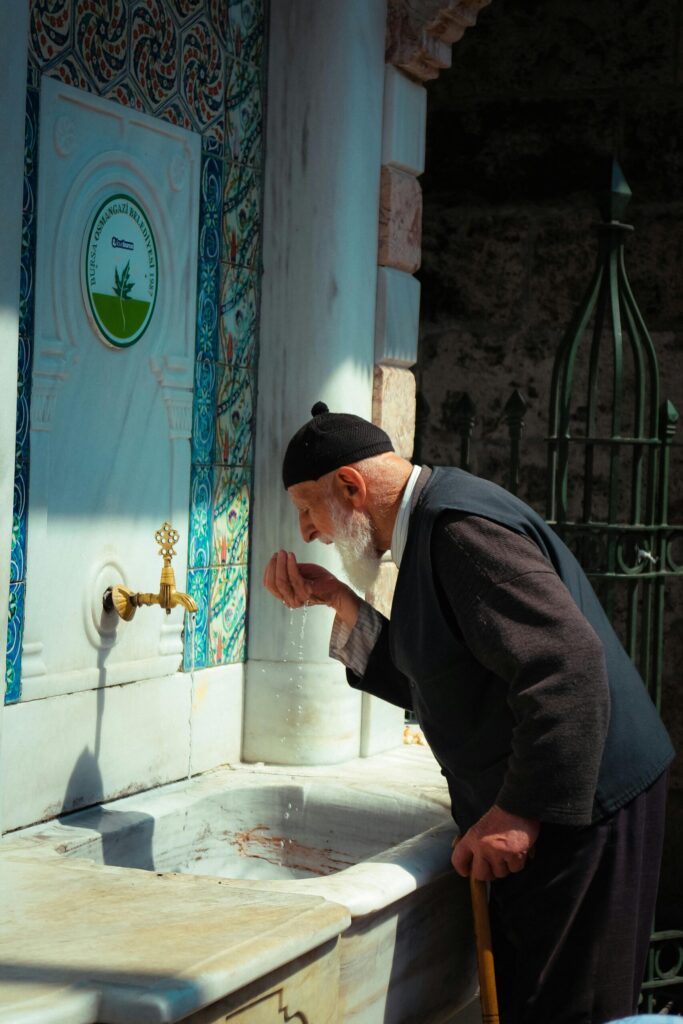
The 7 obligations of ablution
Here is the list of the 7 mandatory points (fard) for wudu to be valid:
- Wash the face
- Wash both hands and forearms up to the elbows
- Pass the wet hand over the head
- Wash the feet up to the ankles
- Follow the prescribed order
- Perform the steps in succession
- Make the intention (niyya)
Missing even one of these points? The ablutions do not count.
Summary table: Obligations vs. Sunna
| Obligations (Fard) | Sunna (Recommended) |
|---|---|
| Wash the face | Say “Bismillah“ |
| Wash the hands and forearms | Wash the hands at the beginning |
| Pass the hand over the head | Rinse the mouth and nose |
| Wash the feet | Wash each part three times |
| Follow the order | Wipe the ears |
| Perform the steps in succession | Start with the right side |
| Make the intention | Rub between the fingers |
The sunna of ablutions
The sunna are the recommended actions, but they are not mandatory. They add an extra dimension and are a source of reward. Key points to remember:
- Wash each part three times
- Start with the right side
- Rub between the fingers
- Wipe the ears
- Say “Bismillah” before starting
Practical tip
To make sure you don’t miss anything, keep a mini checklist on the edge of the sink. It helps you get into the habit, especially at the beginning.
The major ablutions (ghusl): when and how to perform them
The difference between wudu and ghusl
Wudu only involves certain specific areas. Ghusl, on the other hand, is the “full” version: the entire body must be washed. Ghusl must be performed after particular situations, such as after intimate relations, the end of menstruation or childbirth.
Steps of ghusl
For a properly performed ghusl, here are the steps to follow:
- State the intention (niyya)
- Say “Bismillah”
- Wash the private parts
- Perform a complete wudu (as described above)
- Pour water over the entire body: first the head, then the right side, then the left
- Check that no area has been missed (hair, armpits, etc.)
The goal: the entire body must be rinsed, without exception.
Special cases (women, after intimate relations, etc.)
The ghusl is obligatory:
- for women after their period or after childbirth,
- for anyone after intimate relations.
The steps remain the same for everyone, but be sure to wet the roots of the hair and all parts of the body.
Practical tip
Long hair? There’s no need to untangle it completely every time: what matters is that the water reaches the roots.
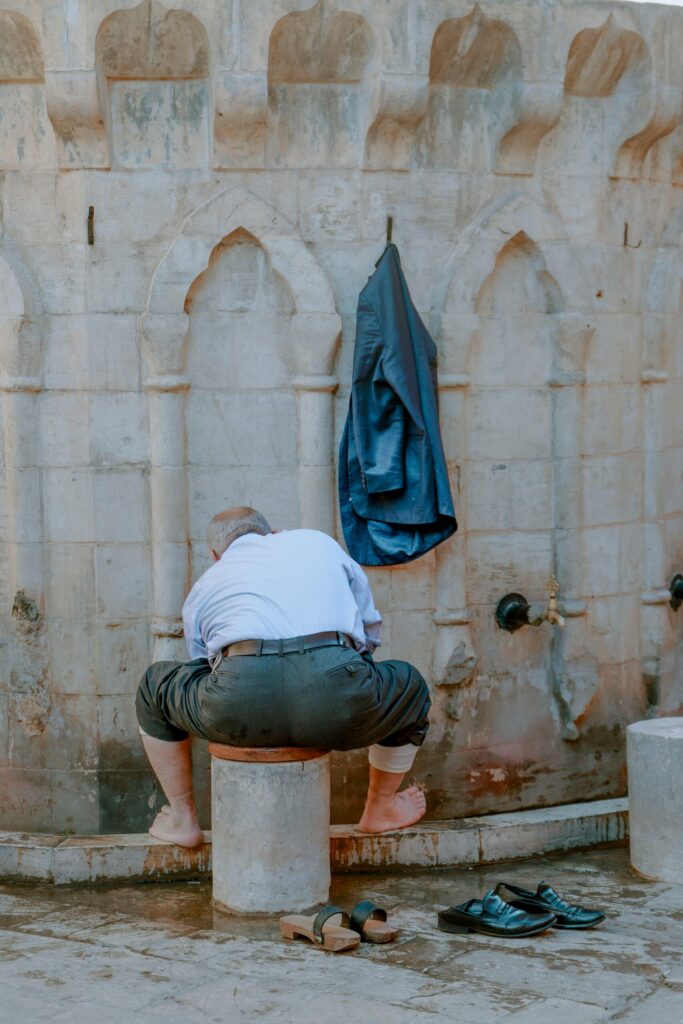
What invalidates ablutions in Islam
List of acts that invalidate wudu
Here is what causes the loss of wudu:
- Anything that naturally exits the body (urine, stool, gas)
- Loss of consciousness (deep sleep, fainting)
- Touching the private parts with a bare hand (according to some schools)
- Significant bleeding (according to some schools)
- Significant vomiting (according to some schools)
After any of these cases, you must perform the ablutions again before praying.
What to do if in doubt?
In doubt? The simplest thing is to perform the ablutions again.
Certainty takes precedence over doubt.
But if the doubt remains, it is better to start over, for peace of mind.
Common mistake
No, laughing or talking does not invalidate the ablutions. It’s a stubborn myth.
Ablutions when water is unavailable (tayammum)
When to use tayammum?
The tayammum is the “waterless” option. It is used when water is lacking, or when you cannot use it (illness, injury, etc.). It allows you to pray even when water is not available.
Steps of tayammum
To perform the tayammum, all you need is a clean natural surface such as earth, sand or a stone. You place or lightly strike both hands on it to pick up a little clean dust: this symbolic dust replaces water for wiping the face and hands.
Here is how to do it:
- State the intention (niyya)
- Say “Bismillah”
- Lightly strike the palms on a clean surface (earth, stone, sand)
- Wipe the face with the palms
- Wipe the hands up to the wrists
The tayammum replaces wudu or ghusl until water is accessible again.
Practical tip
A tissue is not a substitute for a real natural surface. Opt for earth, a stone or clean sand, even if it’s just a corner of the garden.
Conclusion
The ablutions are a solid foundation of Muslim religious practice. They ensure cleanliness before each prayer and serve as a reminder that hygiene is essential. By following the steps and respecting the requirements, you perform this ritual simply and correctly. And if you have a doubt or a particular situation, there is always a solution to remain in a state of purity.
FAQ
To perform the ablutions, begin with the intention and say “Bismillah”. Wash your hands three times, rinse your mouth three times, rinse your nose three times, wash your face three times, wash your forearms up to the elbows three times, pass your wet hands over your head only once, wipe your ears only once, then wash your feet up to the ankles three times, starting with the right one. Follow the order without interruption.
The 7 obligatory acts are:
washing the face, washing the arms, passing a wet hand over the head, washing the feet, following the order, performing the steps in succession, stating the intention.
The ablutions are invalidated if something leaves the body (urine, stool, gas), if you fall into a deep sleep or lose consciousness, if you touch your private parts with a bare hand (according to some schools), or in case of significant bleeding or vomiting (depending on the school).
Wudu is the washing of certain parts of the body.
Ghusl is for the entire body, after a major impurity.
If water is not available, strike your palms on a clean surface (earth, stone), then wipe your face and hands. Tayammum takes the place of wudu or ghusl.