


“Bismillah” literally means “In the name of God” and is used to begin every action under divine blessing.
The word bismillah is heard often: at home, at the mosque, or simply before starting an everyday task. It is a short expression, but one full of meaning, that crosses cultures and generations. Yet many people still wonder what it really means, when to use it, or why it holds such an important place in the lives of Muslims. Behind these few syllables lies a complete philosophy: starting everything with intention, respect and gratitude.
In this article, we dive into the heart of this emblematic phrase to understand its history, its meaning and how it is used in everyday life.
Bismillah meaning: what does this expression mean?
Literal translation and deeper meaning
The expression bismillah comes from three small Arabic words: “bi” (by, with), “ism” (name) and “Allah” (God). Translated word for word, it gives “In the name of God“. But behind this simplicity lies the idea of beginning everything under the gaze and blessing of God. It is not reserved for major rituals: you can place it at the heart of your daily life, whenever you start an action, to give deeper meaning to what you do.
Saying bismillah is also a way of admitting that we do not control everything, that we call upon a higher power. We pause, acknowledge our limits and ask for a helping hand or protection. It is a reflex that encourages gratitude and thinking before acting.
In Muslim culture, bismillah serves as a constant reminder of God’s presence. It encourages us to stay attentive, kind and responsible. Even the simplest gestures take on a new dimension. Ultimately, bismillah is not just a word, but a way of approaching life with respect and intention.
Origin and history of the basmala
The basmala is the full phrase: Bismillah ar-Rahman ar-Rahim. It appears at the opening of almost every surah of the Quran, except one. That says a lot about its importance in Islam. Its use goes back to the early days of the Quran, but the idea of beginning “in the name of God” already existed in other Semitic cultures long before.
Over time, the basmala became part of Muslims’ lives. It found its way into letters, contracts and official speeches, and still marks key moments today: prayers, events, or simple daily habits.
The basmala recalls the mercy and kindness of God, central values in Islam. Used for centuries, it remains a living point of reference that connects generations and cultures. At its core, the basmala is not just a tradition: it is a thread that ties together the past, the present and the need for meaning.
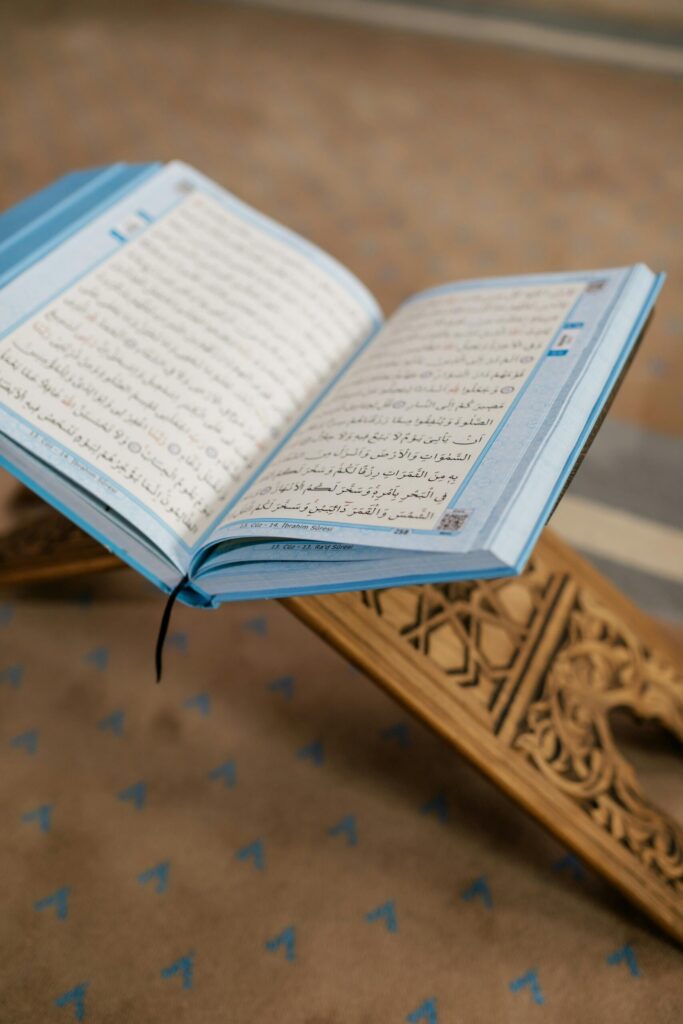
Bismillah in Arabic: writing, pronunciation and calligraphy
How to write and pronounce “bismillah”
In Arabic, bismillah is written بسم الله. Like all Arabic text, it is read from right to left. For pronunciation, just break it down: [biss-mil-lah]. The “s” stays soft, and the “lah” is stressed at the end of the word.
To improve, nothing beats listening to native speakers. There are plenty of audio resources online. A few tips for practicing:
- Split the word into two parts: “biss-mil” then “lah “
- Start slowly, then gradually speed up
- Listen to native speakers to tune your ear
Arabic calligraphy also gives bismillah a visual touch. Even if you are not an expert, writing this phrase by hand helps you understand it better. For those who want to go further, there are video tutorials for learning to draw each letter.
Examples of calligraphy and visual use
The calligraphy of bismillah is a whole art. You can find it on:
- Decorative paintings
- Religious book covers
- Everyday items (mugs, rugs, notebooks…)
- Invitations (weddings, births)
- The walls or domes of mosques
Styles vary by country and era. Some opt for a clean, simple style, while others prefer more intricate patterns, with flowers or geometric shapes. In mosques, the phrase is often displayed in key places, creating an atmosphere of contemplation.
The calligraphy of bismillah is also used to introduce children to Arabic writing, or to symbolize a new beginning, a learning journey. In short, this visual side extends the spiritual dimension of the phrase, while beautifying everyday objects.
Bismillah Rahman Rahim: a complete explanation of the phrase
Breaking down the phrase
The full version, Bismillah ar-Rahman ar-Rahim, translates as “In the name of God, the Most Gracious, the Most Merciful.” Every word counts:
- Bismillah: In the name of God
- ar-Rahman: The Most Gracious
- ar-Rahim: The Most Merciful
This double mention of mercy is there to emphasize God’s generosity and kindness, at the heart of the Muslim faith. The two adjectives invite reflection on the scope of this goodness.
Summary table:
| Term | Translation | Main meaning |
|---|---|---|
| Bismillah | In the name of God | Intention, beginning |
| ar-Rahman | The Most Gracious | Universal mercy |
| ar-Rahim | The Most Merciful | Particular mercy |
This structure gives the phrase a depth and scope that go beyond simple recitation.
Place in the Quran and religious importance
The basmala opens 113 of the 114 surahs of the Quran. It is an essential phrase. It is recited before each surah (except one), but also before many everyday actions. Its omnipresence is a reminder that it is best to begin everything with a good intention.
In practice, the basmala shows respect toward God, and reminds us that mercy is at the center of the relationship between the human and the divine. There is no need to wait for big moments: it finds its place in simple gestures, and turns every action into an act of faith.
It is also a point of reference for learning: young and old alike are taught to begin everything with respect and gratitude. In short, Bismillah ar-Rahman ar-Rahim is both a spiritual guide and a tool for structuring your days. You could say it is the “USB key” of the conscience: always ready to serve!
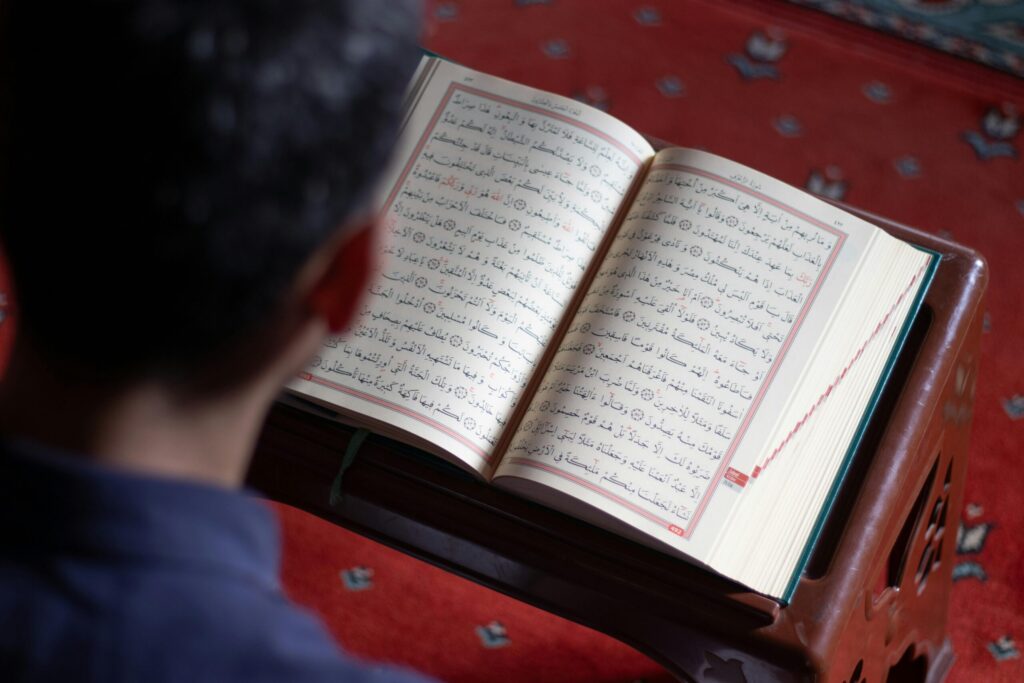
Using bismillah in everyday life
When to say “bismillah”? (before eating, traveling, etc.)
“Bismillah” finds its way into many moments of daily life. A few concrete examples:
- Before eating or drinking, to give thanks and ask for a blessing on the food
- Before hitting the road or traveling
- Before starting a job, a meeting, a project
- Before entering a room, opening a door or going out
- Before writing, reading, or even turning on a device
Sometimes, it is even slipped in before opening the fridge or starting a task. The idea is to begin with a clear intention, without overthinking.
Children learn very early to say “bismillah” before starting an activity or eating. It quickly becomes second nature, a way of adding a spiritual touch to every gesture, without pressure.
Conclusion
“Bismillah” goes far beyond a simple phrase. It connects daily life to the spiritual, and crosses cultures, ages and eras. Its simplicity hides real depth, which encourages reflection, gratitude and putting intention into every gesture. Whether you are a believer, curious, or just a music lover, understanding “bismillah” opens the door to a living and universal tradition. It is up to each person to decide how to adopt it, with respect and awareness. One phrase, a thousand uses, and always this small opening onto what is essential.
FAQ
“Bismillah” means “In the name of God” in Arabic. It is used to begin an action under divine blessing.
It is said before eating, traveling, starting work, or any important action. It is a way of placing what you do under God’s protection.
“Bismillah” is written بسم الله in Arabic and pronounced [biss-mil-lah]. It is simple, with no complicated accent.