


The Muslim prayer beads are known as the misbaha, subha or tasbih. They are used to count invocations (dhikr) and accompany spiritual practice in daily life. They are a key item for meditation in Islam, very different from the Christian rosary in shape, number of beads and use. We go over the essentials to help you understand, use or choose Muslim prayer beads.
In brief
- The Muslim prayer beads go by the names misbaha, subha or tasbih.
- They are used to count invocations (dhikr) and promote meditation.
- They generally consist of 33 or 99 beads, depending on tradition.
- They differ from the Christian rosary in structure and use.
What are Muslim prayer beads called?
The Muslim prayer beads go by several names: misbaha, subha or tasbih. They most often come with 33 or 99 beads, and are used to count invocations (dhikr) in Muslim religious practice. They can be found throughout the Islamic world.
Beyond these three main names, each Muslim culture sometimes has its own way of pronouncing or writing it. This diversity shows the full richness of the traditions surrounding prayer beads. In the Maghreb, people more readily say misbaha; in the Middle East, subha is common; and tasbih emphasizes the act of glorifying God. In short, each word highlights a different facet of the object, but all refer to the same practice.
The prayer beads are not reserved for an elite: they accompany regular practitioners as well as those who simply want to meditate or refocus. Simple to use and full of meaning, they find their place everywhere: at the mosque, at home, in a pocket or set on a shelf, ready to use at any time.

Origin and meaning of the names misbaha, subha, tasbih
- Misbaha: derived from the Arabic “sabaha” (“to glorify”), it emphasizes praising God.
- Subha: literally means “beads of praise” in Arabic, and refers to the object itself.
- Tasbih: refers to the repetition of “Subhan Allah” (“Glory to God”), one of the main invocations.
These three terms are used almost everywhere, even though each region has its preferences.
Each word has its nuance. “Misbaha” stresses the act of glorification, “subha” the object, “tasbih” the repeated words. This variety shows that the Muslim prayer beads are more than a tool: they symbolize the relationship between the person and the divine. Depending on the context, you will hear one or the other, but all point to the same idea: meditating and remembering God.
Differences from the Christian rosary (comparison table)
| Criterion | Muslim prayer beads (misbaha/subha/tasbih) | Christian rosary |
|---|---|---|
| Number of beads | 33 or 99 | 59 |
| Main use | Counting invocations (dhikr) | Reciting prayers (Hail Mary, Our Father) |
| Structure | Beads in a line, sometimes with spacers | Groups of beads, cross |
| Meaning | Meditation, remembrance of God | Meditation on the life of Christ |
| Presence of a cross | No | Yes |
Beyond the number of beads, the Muslim prayer beads stand out by the absence of a cross and a linear arrangement of the beads. The Christian rosary, on the other hand, is organized in clearly defined groups and often ends with a cross. Each is used to pace prayer and meditation, but with a very different symbolism and use. The Muslim prayer beads emphasize the repetition of the names or attributes of God, while the Christian rosary structures meditation around the life of Christ and Mary. Two ways of refocusing, each in its own way.
What are Muslim prayer beads used for?
The Muslim prayer beads are mainly used to count the formulas of remembrance of God (dhikr), whether after prayer or at any time of the day. They help with spiritual focus and meditation, while respecting the recommended number of invocations.
But they are more than a simple counting tool. They also help you anchor yourself in the moment, structure moments of contemplation, and limit distractions. In short, they offer real support for refocusing, away from the surrounding noise.
In Islam, dhikr is essential: it means remembering God by repeating formulas, often after the obligatory prayers or during moments of personal meditation. The prayer beads become a discreet companion, always there to support the spiritual practice. They can be used alone or at gatherings where everyone counts their invocations at their own pace.
There is no need to wait for the formal prayer: the prayer beads can be used at any time, to calm the mind or mark a meditative pause. Simple, effective, and tried and tested for centuries.
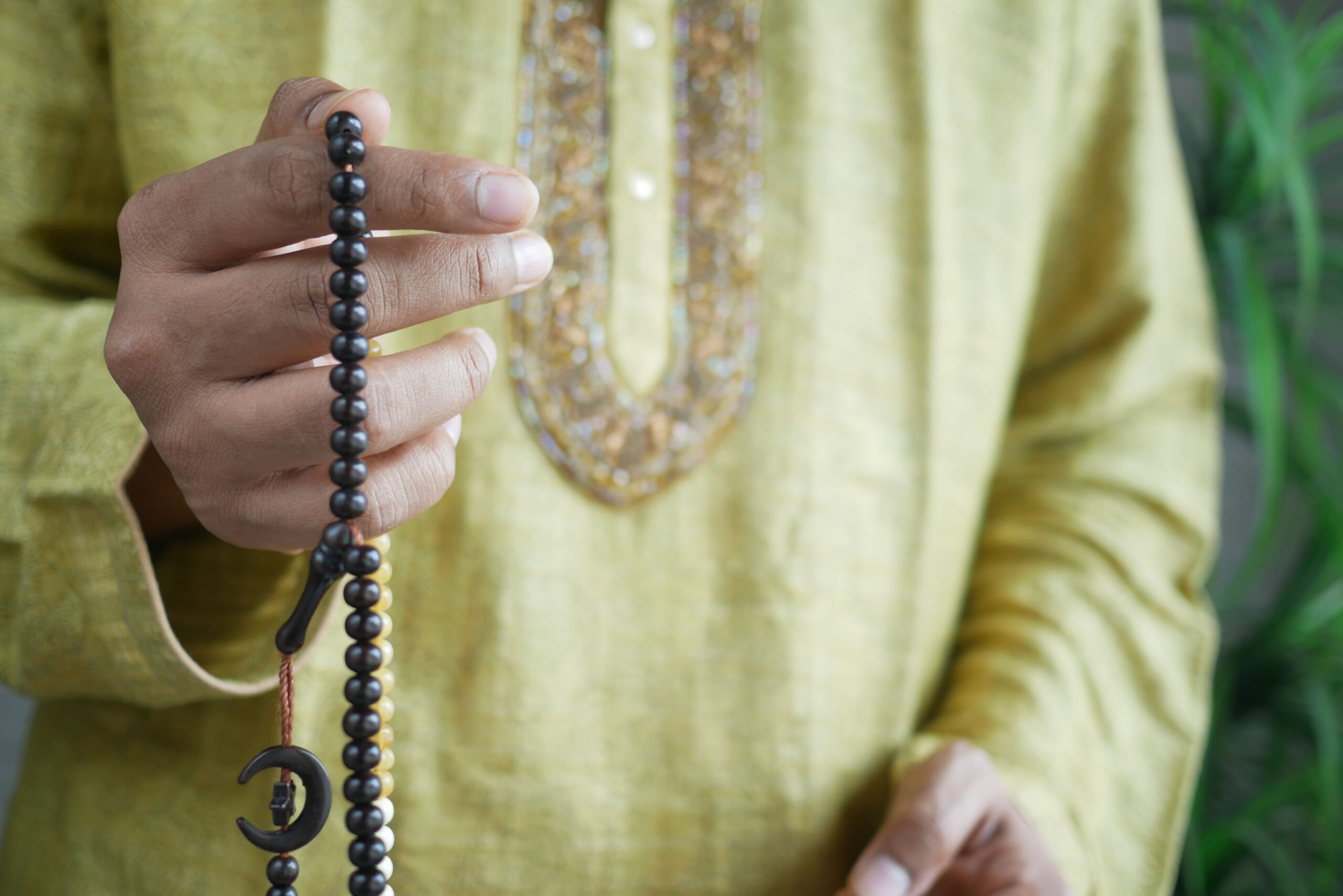
The main invocations recited with prayer beads
- Subhan Allah (“Glory to God”)
- Alhamdulillah (“Praise be to God”)
- Allahu Akbar (“God is the greatest”)
- La ilaha illa Allah (“There is no god but God”)
- Astaghfirullah (“I ask God for forgiveness”)
These formulas are recited individually or in series, often after each ritual prayer.
Each invocation has its own meaning and can be chosen according to the moment or intention. For example, “Astaghfirullah” to ask forgiveness, “Subhan Allah” to glorify. You can alternate or follow traditional recommendations. The prayer beads make all this easier: they keep count, leaving you free to focus on the meaning of each word.
Why 33 or 99 beads?
- 33 beads: for three main invocations, each repeated 33 times (Subhan Allah, Alhamdulillah, Allahu Akbar).
- 99 beads: to recite the 99 names of God (Asma ul-Husna) or to multiply the cycles of dhikr.
- A separator or an extra bead marks the end of the cycle.
Counting beads is like counting sheep, but here you stay wide awake.
The format of the prayer beads is not chosen at random: it is based on the prophetic tradition. 33 beads for the short daily cycles, 99 to meditate on each divine name. Some models add a “master” bead to mark the end of the cycle or to invite a special prayer. It is a simple system, accessible to everyone, beginners and experienced practitioners alike.
How do you use Muslim prayer beads?
To use Muslim prayer beads, simply slide one bead between your fingers with each invocation, until you complete a cycle of 33 or 99 repetitions. This gesture accompanies meditation and lets you keep count without losing focus.
Using them relies on a simple, meaningful gesture: each bead slid after an invocation sets a soothing rhythm, conducive to concentration. There is no need to recite out loud: it can be done in silence, in a low voice or inwardly, depending on your wishes or the context.
The prayer beads can be used during formal prayer as well as in more informal moments, while walking or waiting. They adapt to your pace and fit easily into your routine. The key is to keep the intention and the meaning of every word recited, so that the practice stays alive.
Steps for using prayer beads
- Hold the prayer beads in one hand, between your thumb and index finger.
- Start with the first bead, right after the separator.
- Recite the invocation of your choice (e.g., “Subhan Allah”).
- Slide one bead with each repetition.
- Continue until the last bead.
- Start again if needed for other invocations.
This gesture, even if it seems repetitive, offers a reassuring structure and helps you stay centered. Some people close their eyes, others prefer to keep them open. What matters is finding what works for you.
Tips for getting started
- Choose a simple invocation to begin with.
- Go at your own pace, without pressure.
- Find a quiet moment to concentrate better.
- Let the gesture become a reflex over time.
If you are just starting out, begin with short sessions, then gradually extend the duration or the number of repetitions. The goal is not perfection, but sincerity. With practice, the prayer beads become second nature, a bit like finding your keys in the dark — except here, it is serenity that you find.
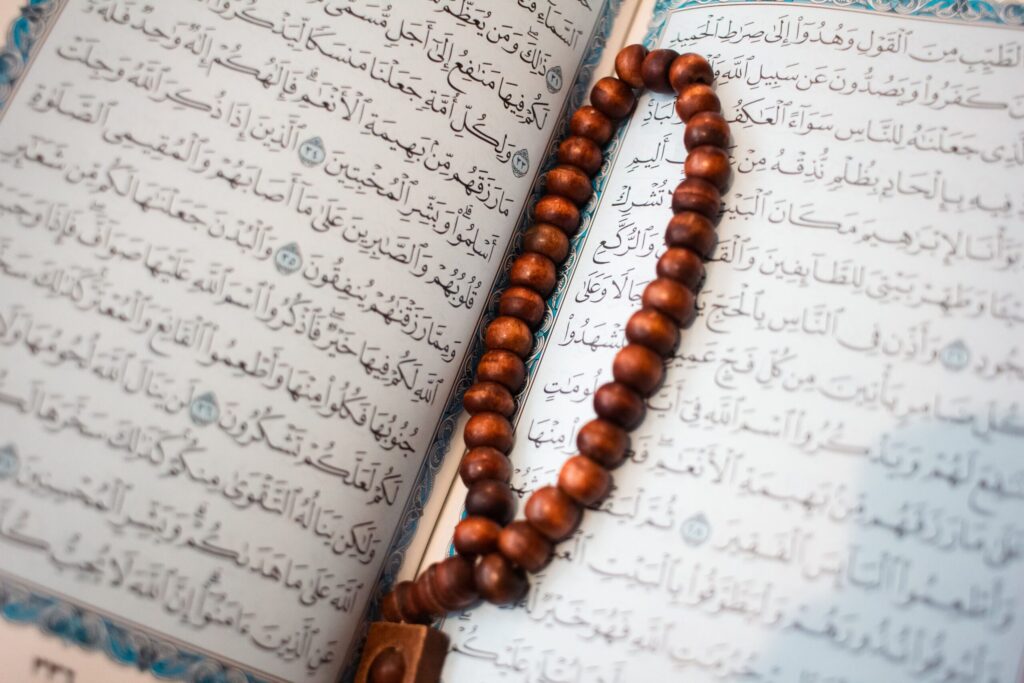
Where can you find Muslim prayer beads and how do you choose them?
You can find Muslim prayer beads in specialty shops, online or in some cultural stores. The choice depends on the material, the number of beads and the intended use. There are simple models and more decorative ones, for every budget.
Take the time to compare: materials vary (wood, stone, plastic, crystal, even precious materials for high-end models). The material affects the feel, the weight and the durability. Some people like the warmth of wood, others prefer the coolness of stone or the shine of crystal.
The number of beads matters too: 33 for simplicity, 99 for longer cycles or for the 99 names of God. The size of the beads affects comfort, especially if you use them often. And in terms of looks, it can matter if you want to give the prayer beads as a gift or leave them on display.
If possible, try several models before choosing. Prayer beads that feel pleasant to the touch and are sturdy will be your companion for a long time.
Selection criteria
- Number of beads (33, 99 or other)
- Material (wood, stone, plastic, crystal)
- Bead size (small or large)
- Strength of the thread or cord
- Look (simple or decorative)
- Use (daily, gift, collection)
Each criterion can change the experience. Lightweight wooden prayer beads will be easy to carry, while a stone model will feel different under the fingers. For daily meditation, prioritize durability and comfort. For a gift, also think about the appearance and the presentation.
Precautions to take when buying
- Check the strength of the thread so the prayer beads don’t break quickly.
- Choose a material that feels pleasant to the touch.
- If it’s a gift, find out about the person’s tastes.
- Avoid overly fragile models if you plan to use them often.
A sturdy set of prayer beads that is pleasant to handle will save you a lot of trouble. Also think about care, especially for natural materials. If in doubt, ask for advice or check the online reviews. A good set of prayer beads is like a good pair of shoes: it should be comfortable, reliable, and no-frills.
Conclusion
Prayer beads for Muslims, known as misbaha, subha or tasbih, are an essential spiritual object for dhikr. They help count invocations, deepen meditation and maintain a spiritual anchor in daily life. Easy to use, they come in many forms, for every need and every taste.
FAQ
Muslim prayer beads are called misbaha, subha or tasbih. These three words refer to the same object, used for reciting invocations.
Muslim prayer beads generally have 33 or 99 beads, while the Christian rosary has 59. Their use and meaning vary depending on the religious tradition.
Simply slide one bead for each invocation recited, until you complete the cycle of 33 or 99 repetitions depending on the model.
It is used to count invocations (dhikr) and accompanies meditation and prayer in Muslim practice.
You can find them in specialty shops, online, or in some cultural stores that offer religious items.
Leave a Reply