


The rules of marriage in Islam rest on four essential pillars: the consent of both spouses, the presence of a guardian for the woman, the dowry (mahr) and two adult Muslim witnesses. Without these elements, a religious marriage has no validity. Knowing how these rules work means avoiding mistakes and making sure the marriage truly respects Islamic tradition.
In brief:
- An Islamic marriage requires four conditions: consent of both spouses, a guardian for the woman, a dowry, and two Muslim witnesses.
- Each condition serves a purpose: protecting rights and ensuring the contract is clear.
- The marriage follows specific steps, from consent to signing.
- Obligations and prohibitions frame the union to ensure ethics and religious legality.
The pillars and conditions of Islamic marriage
A marriage is valid in Islam only if these four conditions are met: consent of both spouses, a guardian for the woman, a dowry, and two adult Muslim witnesses. These pillars establish the legitimacy and transparency of the religious marriage.
| Condition | Mandatory | Exceptions / Special cases | Main role |
|---|---|---|---|
| Consent of the spouses | Yes | None | Free agreement of both parties |
| Guardian (wali) for the woman | Yes | Hanafi school: not mandatory | Protect the interests of the future bride |
| Dowry (mahr) | Yes | Symbolic amount accepted | The woman’s right, a mark of commitment |
| Two Muslim witnesses | Yes | None | Ensure publicity and validity of the contract |
Each condition serves to protect the rights of the future spouses and to clarify the contract. Consent is the foundation: there is no marriage without a genuine agreement on both sides. The guardian looks after the woman’s interests, especially if she is in a vulnerable position. The dowry symbolizes the husband’s commitment and remains a personal right of the wife. The witnesses, finally, make the marriage public and prevent any dispute. All Muslim schools of law recognize these pillars, even if some details sometimes differ. Respecting these rules means obtaining religious and social recognition of the marriage.
The consent of both spouses
A marriage in Islam does not exist without the free and clear consent of both spouses. Without this agreement, the religious contract has no validity.
This consent is not just a formality: it protects each person’s freedom and prevents any coercion, whether family-related or social. Traditionally, this yes is expressed before witnesses, sometimes in the presence of an imam or a qualified person. It must be given in full awareness, without pressure or manipulation. If the consent is not sincere, the marriage is annulled. Sometimes, prior interviews are held to make sure each party fully understands what marriage entails. Until the signing, either party can withdraw consent, which reinforces the protection of individual rights.
The guardian (wali): role and importance
The presence of a guardian (wali) is essential for the marriage of a Muslim woman, except for an exception in the Hanafi school. The wali gives official approval during the contract and looks after the interests of the future bride.
The choice of the wali follows an order: first the father, then another close male relative (brother, uncle, grandfather, etc.). This is not a symbolic role: the wali must verify that the suitor is reliable and that all conditions are met. He can also step in if there are doubts, protecting the woman from hasty decisions. If the family is absent or in the case of a conversion, a religious authority or a trusted person can become wali. This rule aims to prevent the future bride from being isolated or vulnerable. The wali may refuse a marriage, but only for serious reasons, not arbitrary ones. In the Hanafi school, an adult woman may marry without a wali, but this case remains rare and regulated.
The witnesses: who and how many?
At least two adult Muslim witnesses are needed to validate a religious marriage. Their presence ensures the publicity of the act and its legitimacy.
To be a witness, one must be Muslim, of age, responsible and of sound mind. Witnesses must be impartial: neither the future spouses nor the guardian. Their role is to prevent secret marriages and guarantee transparency. They attend the conclusion of the contract and attest that all conditions are met. In some communities, respected individuals are preferred to strengthen the credibility of the act. Witnesses may be called upon in the event of a dispute. Their presence also roots the couple in the life of the community.
The dowry (mahr): obligation and terms
The dowry (mahr) is mandatory in Islamic marriage. It is a personal right of the woman, set before the marriage is celebrated.
The dowry can be a sum of money, a piece of jewelry, a material asset or even a symbolic commitment. What matters is that it is clearly defined and freely accepted by the future bride. The amount or form of the dowry often depends on local customs, but it must remain reasonable. The dowry can be paid immediately or later, depending on the agreement between the spouses. It belongs exclusively to the woman, who may do with it as she wishes. If the dowry is not set at the time of the marriage, it must be set afterward, in agreement with all parties. This rule recognizes the husband’s commitment and offers financial security to the wife. The dowry is never a purchase price, but a sign of respect and responsibility.
How the marriage contract unfolds in Islam
The Islamic marriage contract takes place in several stages: proposal, acceptance, presence of the guardian, setting of the dowry, witnessing. Each step follows a precise order to guarantee religious validity.
The main steps of a religious marriage in Islam:
- Marriage proposal (khitbah) and discussions between families
- Agreement on the dowry (mahr) and its terms
- Presence of the guardian (wali) for the woman
- Meeting in front of two adult Muslim witnesses
- Statement of the offer (ijab) and the acceptance (qabul) by the spouses or their representatives
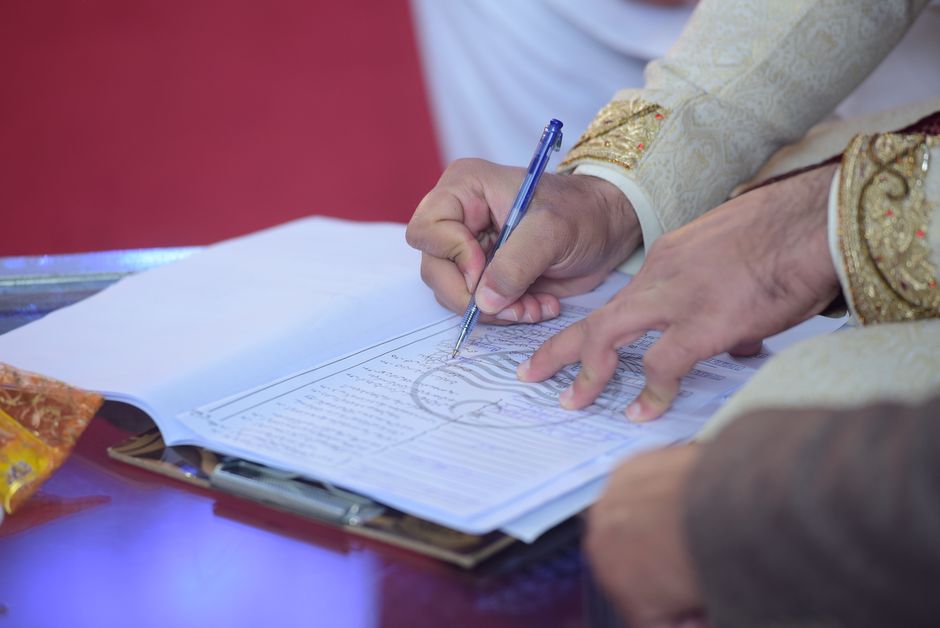
- Signing or declaration of the marriage contract (nikah)
- Public announcement of the union (recommended but not mandatory)
Each step has a specific purpose. The proposal starts the conversation and clarifies expectations. The dowry and the guardian protect the woman’s rights. The witnesses ensure transparency. The offer and acceptance make the commitment official. The public announcement, even though it is not mandatory, is strongly advised: it prevents misunderstandings and brings the couple into the community. This structured process protects the spouses and limits the risk of conflict.
The steps of the religious marriage
The religious marriage begins with an official proposal, followed by the negotiation of the dowry and the verification of the conditions. The families meet, often with an imam or a qualified person, to make sure everything is in order. The woman’s guardian plays a central role during this meeting. Once the conditions are validated, the spouses or their representatives pronounce the formulas of offer and acceptance in front of the witnesses. The contract is then sealed, and the union can be announced publicly.
After the proposal, the families discuss practical matters: place of residence, expectations, organization of the ceremony. The dowry is negotiated with respect for everyone involved. During the meeting, the guardian makes sure that the future wife gives her consent freely. The witnesses confirm that the procedure is in order. The offer and acceptance (ijab and qabul) are stated solemnly, to mark the importance of the commitment. Once the contract is signed, it is recommended to announce the marriage to the community, for example during a meal or a group prayer. This strengthens the legitimacy of the union and makes it easier for the couple to integrate.
Formulas and acceptance
The wording of the contract rests on two key phrases: the offer (ijab) and the acceptance (qabul). One party proposes the marriage, and the other clearly accepts, in front of the witnesses.
These formulas can be pronounced by the future spouses themselves or by their representatives (guardian or family member). What matters is that the words are clear and unambiguous. The imam or the person in charge of the marriage checks that everyone fully understands what they are committing to. This step makes the consent official and marks the beginning of married life according to Islam. The phrases can be simple or more elaborate, depending on tradition, but must always express a firm and shared intention. In case of doubt, it is better to postpone the signing of the contract: better safe than sorry.
Particularities according to the schools (Maliki, Hanafi, etc.)
The main schools of Islamic law (Maliki, Hanafi, Shafi’i, Hanbali) share the main principles, but some differences exist, especially regarding the role of the guardian.
- Maliki, Shafi’i, Hanbali schools: guardian required for the woman.
- Hanafi school: an adult woman may marry without a guardian.
- On the dowry and the witnesses, there is almost complete consensus.
- Some schools accept specific arrangements for the dowry or the publicity of the marriage.
The differences come from interpretations of the texts and from cultural contexts. For example, the Hanafi school, present in South Asia, gives more autonomy to the adult woman, whereas the other schools insist on the protection of the guardian. For the dowry, all agree on its importance, but some tolerate symbolic or deferred forms. The question of the witnesses is a matter of consensus, even though the choice may vary according to custom. It is therefore advisable to refer to the school followed by the family or the community to settle particular cases. In case of doubt, consulting a qualified religious authority remains the best solution.
Obligations and prohibitions of marriage in Islam
In Islam, marriage comes with obligations such as mutual respect, fidelity, and respect for each person’s rights. Certain prohibitions also apply, such as marriage to a close relative or to a person who is already committed.
Main obligations of Islamic marriage:
- Respect and kindness between the spouses
- Fidelity and loyalty
- Material and moral support (support, housing, upkeep)
- Protection of each person’s rights and duties
- Raising children in respect of Islamic values
These obligations lay the foundations of a stable and balanced household. Mutual respect means listening and handling disagreements wisely. Fidelity protects the couple’s trust. Material support falls mainly to the husband, but the wife also contributes to the harmony of the household. The education of the children is shared by both, in respect of religious values. Each must ensure a fair distribution of tasks and responsibilities. These principles are not just theoretical: they guide daily life and help overcome difficulties.
Major prohibitions of marriage in Islam:
- Marrying a close relative (mahram): mother, sister, aunt, niece, etc.
- Marrying a person who is already married (polygamy limited to four wives for the man, prohibited for the woman)
- For the Muslim woman: marrying a non-Muslim
- Temporary marriage (mut’a) prohibited in the majority of schools
- Marriage without consent or under coercion
- Secret marriage, without witnesses or guardian (except for the Hanafi exception)
These prohibitions protect the family, morality and social cohesion. Marrying a close relative is prohibited for health reasons and to protect family ties. Polygamy, even though permitted for the man, remains very strictly regulated. Temporary marriage, although present historically, is rejected by the majority of schools. Consent and the publicity of the marriage protect against unlawful unions. Each prohibition aims to guarantee the stability and dignity of the couple, while avoiding conflicts of interest.
The religious obligations of the spouses
The spouses have a duty to respect and support each other and to preserve the dignity of their household. The husband must provide for material needs, and the wife looks after family harmony. Both are responsible for the education of the children and for upholding religious values.
In everyday life, this means sharing tasks fairly, communicating openly and offering support during difficult times. Respecting religious obligations also means praying together, taking part in the festivals and passing on the principles of Islam to the children. Each spouse must avoid harming the other’s reputation, whether in public or in private. Conflicts must be handled with patience and dialogue. Solidarity between spouses is essential to face hardships and build a peaceful home.
Cases where marriage is forbidden
Certain marriages are strictly forbidden in Islam, such as those between close relatives, with people who are already married or, for a woman, with a non-Muslim. These prohibitions preserve the family structure and religious ethics. Other special cases exist depending on the schools of thought or personal situations (adoption, conversion, etc.).
For example, adoption does not establish a religious kinship bond, which can affect the validity of a marriage. Converts sometimes need to regularize their situation according to Islamic law. Marriages concluded under doubtful circumstances (pressure, deception, absence of witnesses) can be annulled. Some marriages are discouraged, even if they are not formally forbidden, such as in cases of obvious incompatibility. In all cases, it is better to consult a specialist in Islamic law to make sure the marriage is valid.
Conclusion
Marriage in Islam rests on clear foundations: consent, guardian, dowry, witnesses. These rules protect everyone’s rights and guarantee the transparency of the religious contract. Respecting them means ensuring a peaceful union in line with Islamic ethics. Before committing, take the time to check that all the conditions are properly met.
Leave a Reply