


The five obligatory prayers in Islam – Fajr, Dhuhr, Asr, Maghrib and Isha – are daily landmarks. Each one has its own specific time window and its number of rakats, which structures the day and constantly reminds us of one of the foundations of the Muslim faith.
In brief:
- The 5 prayers are Fajr (dawn), Dhuhr (noon), Asr (afternoon), Maghrib (sunset), Isha (night).
- Each prayer has a specific time, tied to the position of the sun.
- The number of rakats varies depending on the prayer: 2 to 4 units.
- These prayers are obligatory for every adult Muslim.
The names and order of the 5 prayers in Islam
The five obligatory Muslim prayers, in order, are: Fajr (dawn), Dhuhr (noon), Asr (afternoon), Maghrib (sunset) and Isha (night). Each prayer has an Arabic name and takes place at a very specific moment of the day.
Remembering this order makes daily practice easier. The names themselves are linked to the stages of the day, which helps you find your bearings quickly. For example, Fajr heralds the calm of the morning, Dhuhr marks the midday pause, Asr accompanies the late afternoon, Maghrib signals twilight, and Isha invites the tranquility of the night. This rhythm, from sunrise to sunset, offers landmarks and encourages you to stop regularly, even in the middle of a rush, to reconnect with what matters most.
Summary table of the 5 prayers (Arabic name, translation, time of day)
| Arabic name | English translation | Time of day |
|---|---|---|
| Fajr | Dawn | Before sunrise |
| Dhuhr | Noon | After the zenith |
| Asr | Afternoon | Late afternoon |
| Maghrib | Sunset | Just after sunset |
| Isha | Night | Beginning of the night |
This table clearly summarizes how the prayers mark the day. It is a simple tool for staying on track, especially when you are just starting out or when helping children learn. Visualizing these moments makes it easy to fit prayer into your routine, even when your schedule is overflowing.
Why this order? (logic and meaning)
The order of the prayers follows the rhythm of the sun, creating a continuous link between the believer and God throughout the day. Each prayer calls for discipline and reflection, from morning to evening.
This division is no accident: it invites regularity and punctuality. Fajr, very early, begins the day in serenity, while Isha closes it in calm. The prayer times, sometimes close together, sometimes spaced apart, offer pauses to catch your breath, reflect and give thanks. This organization helps maintain a balance between activity and spirituality, while reminding us that faith is lived at every moment, from the first ray of sunlight to the last. A true guiding thread to keep you on course even when the day speeds up.
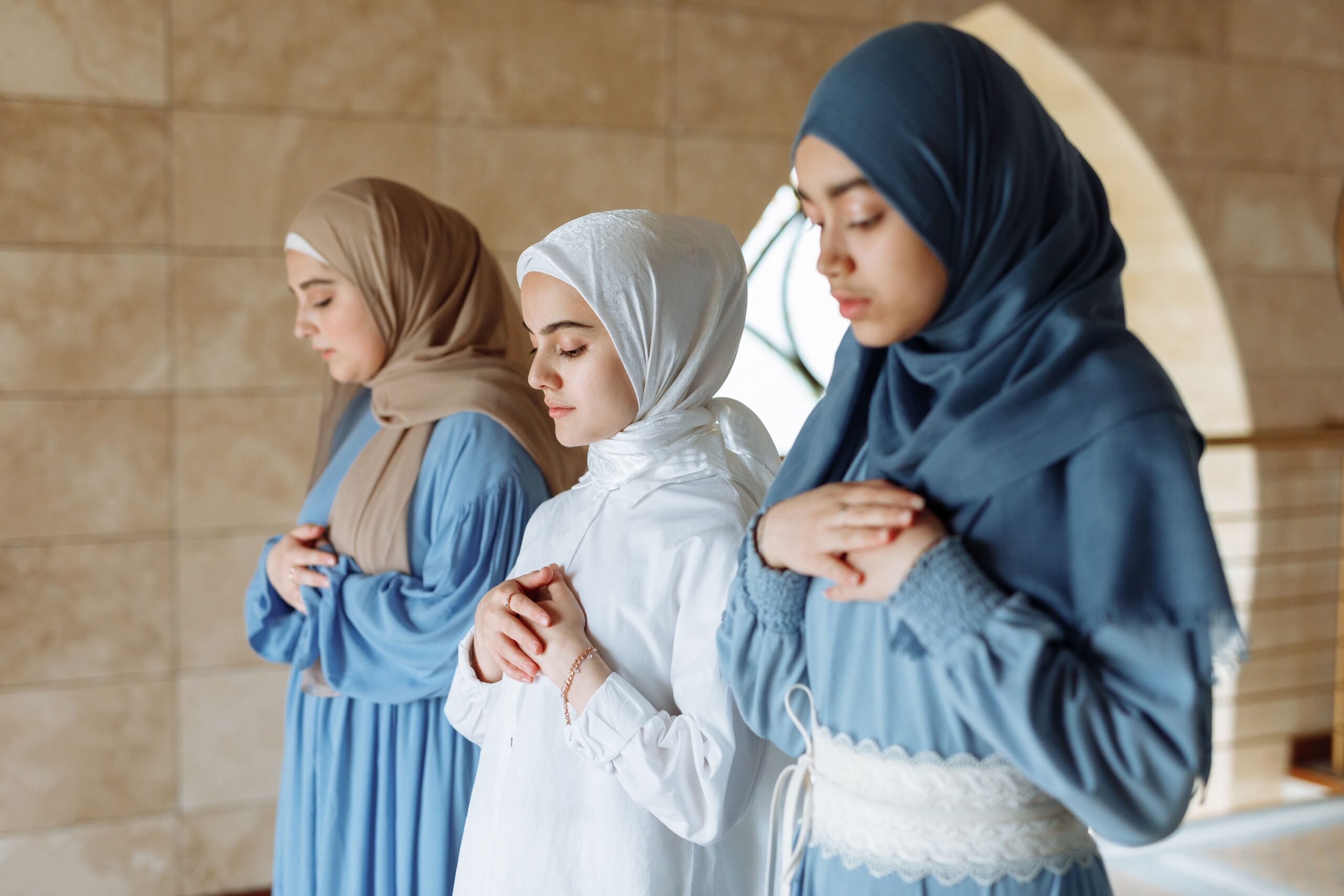
The times of each Muslim prayer
Each Muslim prayer has a specific time, determined by the position of the sun: Fajr at dawn, Dhuhr at noon, Asr in the late afternoon, Maghrib at sunset, and Isha at night.
These times are never fixed to the exact minute, because they change depending on the region and the season. Fajr is always performed before sunrise, Dhuhr follows the zenith, Asr falls in the late afternoon, Maghrib comes just after sunset, and Isha begins the night. This natural rhythm accompanies everyday life.
In reality, the times shift from one day to the next, sometimes barely noticeably. In summer, the days stretch out and the prayers of Dhuhr, Asr, Maghrib and Isha come later. In winter, everything tightens. This flexibility is a reminder that religious practice adapts to nature. To avoid mistakes, it is advisable to check the times regularly, especially when traveling or when the season changes.
List of typical times (with a note on variation by region)
- Fajr: before sunrise
- Dhuhr: after the zenith (solar noon)
- Asr: late afternoon
- Maghrib: just after sunset
- Isha: beginning of the night
Note: The times change depending on the region, the season and the latitude. It is best to consult a local calendar or a dedicated app to be sure.
These typical times are good landmarks, but they should always be adapted to your location. For example, near the poles, day and night can be very different from what we know elsewhere. The calendars distributed in mosques or specialized apps take these differences into account. The result: you can pray with peace of mind, wherever you are.
How to find your way easily? (apps, calendars)
To avoid mistakes with the times, there are mobile apps, specialized websites and calendars distributed at mosques. These tools rely on geolocation and automatically adjust the prayer times.
The apps are super handy: they send reminders for each prayer, offer notifications and display the day’s times in real time. Specialized websites also offer detailed tables, sometimes printable. Paper calendars remain reliable for those who prefer to limit screens. And if you have the right gear, some smartwatches also display prayer times. What matters is choosing what suits you day to day – the simplest option is often the best.
-
-16 %

Women's set with loose top and long skirt
Original price was: 57,60 €.48,00 €Current price is: 48,00 €.Select options This product has multiple variants. The options may be chosen on the product page -
-25 %

Qamis black for men
Original price was: 33,60 €.25,20 €Current price is: 25,20 €.Select options This product has multiple variants. The options may be chosen on the product page -
-20 %

Qamis men's mandarin collar – Lightweight casual fabric
Original price was: 30,00 €.24,00 €Current price is: 24,00 €.Select options This product has multiple variants. The options may be chosen on the product page


The number of rakats for each prayer
Each obligatory prayer has a specific number of rakats: Fajr (2), Dhuhr (4), Asr (4), Maghrib (3) and Isha (4). These units are part of the rhythm of the prayer.
The rakats are cycles made up of movements and recitations. Their number varies depending on the prayer, which changes the duration and intensity of each moment. This regular structure helps you stay focused and not lose your place.
Each rakat follows a sequence: bowing, prostration, recitation. This creates a kind of spiritual breathing with every prayer. The shortest ones, like Fajr, let you ease into the day; the longest ones, like Dhuhr or Isha, offer a longer time for meditation. This variety prevents routine and keeps your attention alert at every step.
Table of rakats per prayer
| Prayer | Number of obligatory rakats |
|---|---|
| Fajr | 2 |
| Dhuhr | 4 |
| Asr | 4 |
| Maghrib | 3 |
| Isha | 4 |
This table makes the structure of each prayer easy to remember. It can be displayed in the prayer space or tucked into a notebook. For beginners, it’s a real reminder to avoid mistakes in the number of cycles.
Why this number of rakats?
The number of rakats for each prayer was set according to the tradition of the Prophet. This distribution balances the day between shorter and longer moments, while keeping the practice regular and accessible.
This choice is not random: it allows for alternating between shorter prayers (at waking and at bedtime) and longer moments of reflection in the middle of the day. It helps adapt to the real rhythm of life, while keeping spirituality at the center. And if you sometimes mix up the number of rakats, don’t panic: even regular worshippers can have doubts, it’s part of the journey!

The importance of the 5 prayers in Islam
The five prayers are a central pillar of Islam, obligatory for every adult Muslim. They give rhythm to the day and strengthen spirituality.
The prayer (Salat) is the second pillar of Islam. It expresses submission to God, discipline and the solidarity of the Muslim community. Praying five times a day keeps a constant connection with faith and helps organize your time around moments of reflection.
Beyond the ritual, prayer has a real impact on spiritual life. It provides regular pauses to refocus, reflect and give thanks. Even when praying alone, you feel a sense of belonging to a worldwide community. Prayer also encourages punctuality, patience and perseverance. It helps protect against stress, invite inner peace and give meaning to each day. In short, it’s a common thread that structures life.
Prayer as a pillar of Islam
Prayer is one of the five pillars of Islam, along with the declaration of faith, almsgiving, fasting and pilgrimage. It is a central act, obligatory for every adult Muslim.
Being a pillar is no small thing: it shows that prayer is at the heart of building faith and Muslim identity. It engages everyone, individually and collectively. The five pillars form a solid foundation; prayer, for its part, embodies regularity and faithfulness in religious practice.
Which is the most important prayer?
All prayers are essential, but Fajr (the dawn prayer) is often seen as the most meritorious. It requires a particular effort, since it takes place very early, and reflects the sincerity and discipline of the believer.
Getting up before the sun for Fajr is not always easy, especially in winter or after a short night. This effort is valued in the tradition, as it shows a willingness to put faith before comfort. Many feel that starting the day with Fajr brings a special energy and peace. It’s a bit like a morning boost, but without the caffeine.
Why pray five times a day?
Praying five times a day gives life a rhythm built around moments of spirituality, discipline and remembrance of God. This frequency helps you stay centered and strengthens the bond with the community.
Repeating the prayer throughout the day keeps the divine presence in mind and invites reflection, even amid the hustle and bustle. Communal prayer at the mosque strengthens social bonds. Individually, this regularity develops patience, organization and self-control. In short, praying five times a day is like maintaining your spiritual fitness: you train, you progress, and you keep your balance.
Conclusion
The five Muslim prayers – Fajr, Dhuhr, Asr, Maghrib and Isha – organize the believer’s day and are at the heart of Islamic practice. Each has its own time, its number of rakats and its meaning. Their regularity strengthens spirituality, discipline and the bond with the community. To find your way, simply follow the order, check local prayer times and keep in mind their central place in the Muslim faith.
Leave a Reply