


The major ablutions (ghusl) are a complete ritual washing of the body prescribed in Islam to regain religious purity.
The major ablutions, also called ghusl, are among the important practices in Muslim religious life.
For women, it is a key step to regain ritual purity after certain moments of daily life.
This guide gets straight to the point: when to perform ghusl, how to do it step by step, the pitfalls to avoid, and answers to all the frequently asked questions.
When should women perform the major ablutions?
The major ablutions are not something to do every morning. They become obligatory in specific cases. Here are the main situations in which they are required.
After menstruation and postpartum bleeding
When menstruation (periods) or postpartum bleeding (bleeding after childbirth) ends, performing ghusl is essential. It allows you to pray, fast or read the Quran with peace of mind.
After sexual intercourse
After any sexual intercourse, ghusl becomes obligatory, even if there was no ejaculation. It is a clear rule, valid for women and men alike.
Other cases where ghusl is obligatory
Other situations also require ghusl:
- conversion to Islam,
- emission of semen accompanied by pleasure,
- washing of the deceased in the event of a death.
But in everyday life, the three cases mentioned above are the ones that come up most often.
How do women perform the major ablutions: detailed steps
No need to make things complicated, ghusl is done in a few simple steps. A shower is more than enough, no Olympic-size bathtub required.
The Intention (niyyah) and the Phrase “Bismillah”
Begin by making the intention in your heart: “I am performing ghusl to purify myself.”
Say “Bismillah” (“In the name of God”) before you begin.
The intention is the foundation: without it, the ghusl is not valid.
Washing the Hands and Private Parts
Wash your hands three times.
Thoroughly clean the private parts to remove any trace of impurity.
The Minor Ablutions (wudu) Included
Then perform the usual ablutions (wudu): face, arms, head, feet.
Washing the Head and Hair
Pour water over the head three times, paying special attention to the roots.
If your hair is long or braided, there is no need to undo it completely each time: what matters is that the water reaches the scalp well.
It is recommended to pour the water three times over the head, as the Prophet ﷺ did, but it is not obligatory. The minimum for the ghusl to be valid is that the water properly reaches the scalp, even if it is only once.
Washing the Entire Body
Pour water over the whole body, starting with the right side, then the left.
Rub lightly so that the water reaches everywhere, even hidden areas (armpits, behind the knees…).
Check that no dry area remains.
⭐ → Supplication after the ablutions (wudu), to be said right after this step
Since ghusl includes wudu, the authentic supplication can be said immediately after the minor ablutions:
“I bear witness that there is no god but God, and I bear witness that Muhammad is His servant and His messenger.
O God, make me among those who repent, and make me among those who purify themselves.”
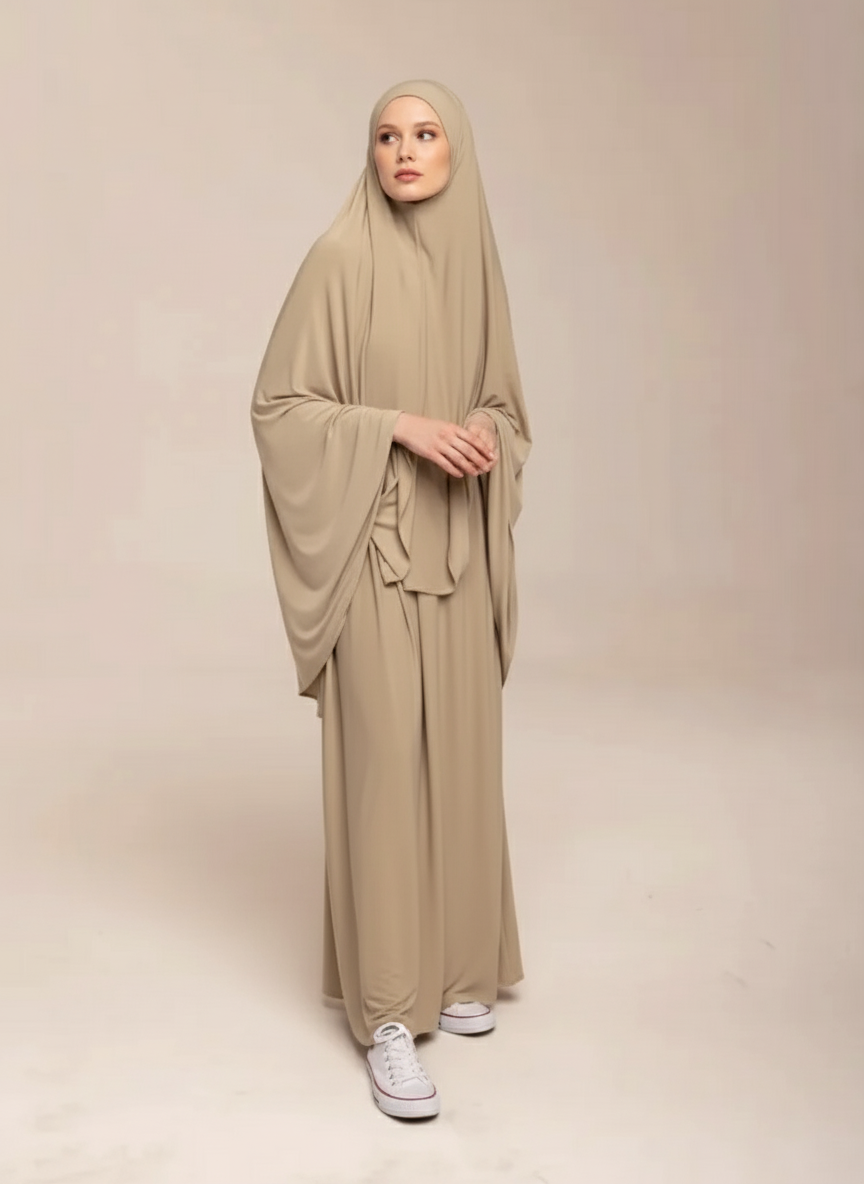
Prayer Outfit
A Comfortable Prayer Outfit
Comfortable and modest outfits – For women & men
What Invalidates the Major Ablutions for Women
Certain situations cause the purity of the ghusl to be lost. Knowing them helps you avoid unpleasant surprises.
Discharges, Menstruation, Intercourse
If your period or postpartum bleeding (lochia) returns, or after another sexual relation, the ghusl is no longer valid. You will then need to repeat the major ablutions to regain purity.
(Please note: everything that invalidates wudu — sleeping, going to the bathroom, passing gas, etc. — does not invalidate the ghusl, only the minor ablutions.)
Differences between major and minor ablutions
The ghusl is required after major events (period, sexual relations, etc.).
The minor ablutions (wudu) are enough for everyday situations: before prayer, after sleeping, etc.
If you have performed the ghusl completely, there is no need to repeat the wudu: it is included.
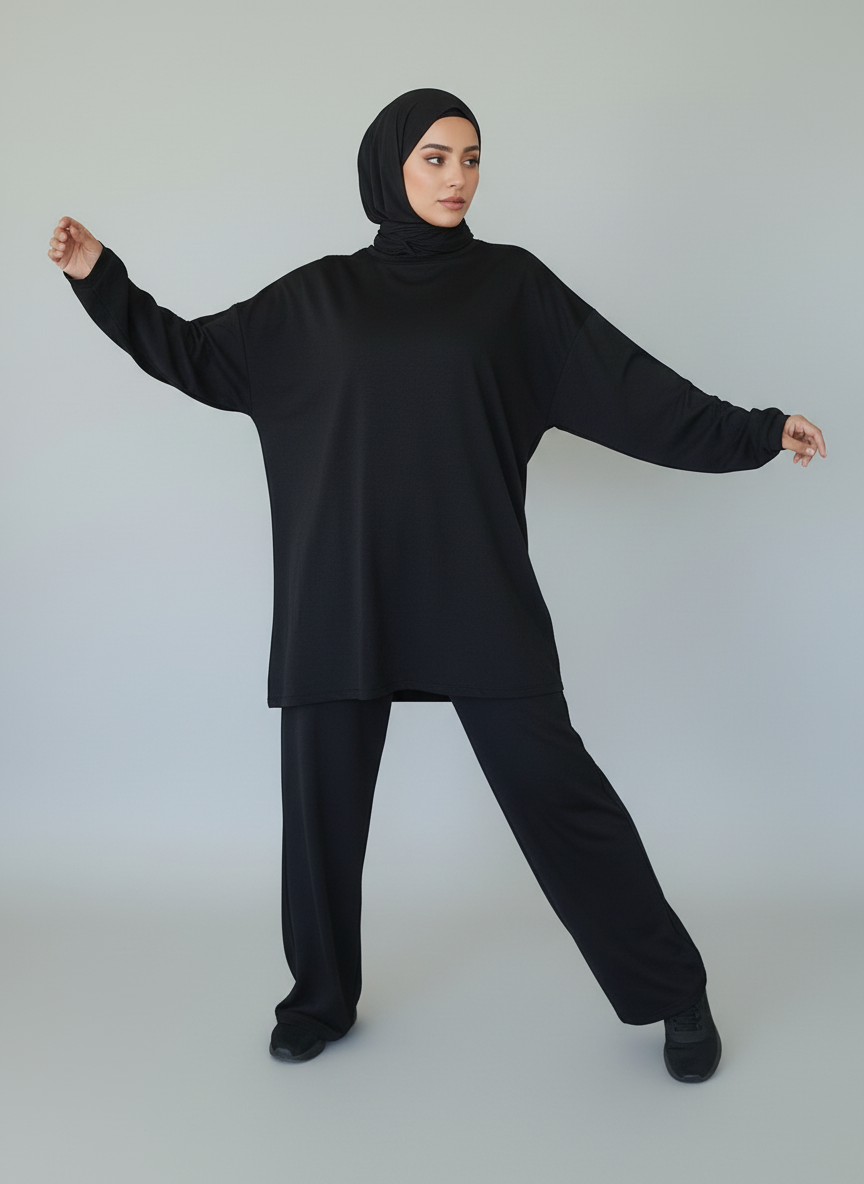
Women’s set
A set you can breathe in
Wear it however you like, at home or out and about.
Special cases (long hair, braids, etc.)
Long, braided or tied-up hair? There is no need to undo everything each time.
What matters is that the water reaches the scalp.
If your braids are very tight, it can help to loosen them a little to let the water through.
Practical tips for performing your major ablutions successfully
A few tips for a ghusl that is simple, effective and hassle-free.
Common mistakes to avoid
A few classic oversights:
- Skipping the intention (niyyah)
- Forgetting a spot on the body (behind the ears, between the fingers…)
- Not wetting the scalp
- Rushing without checking that everything is properly washed
Tips for long hair
Tie your hair up, but not too tightly.
Let the water run all the way to the roots.
With braids, check that the water reaches the scalp.
There is no need to use shampoo every time: here, what counts is the ritual purification, not the blow-dry.
Hygiene and respect for privacy
Choose a quiet place where you feel comfortable.
Use clean water at a comfortable temperature.
Keep your modesty, even if you are alone. It is a moment for yourself, in peace.
Conclusion
The major ablutions are among the basics of staying in a state of purity in Islam. By following the steps, everything becomes simple and serene. What truly matters: the intention, the method, and confidence in your way of doing it.
FAQ
Make the intention, say “Bismillah”, wash your hands and private parts, perform the minor ablution (wudu), wash your head and hair, then wash your whole body, starting with the right side, then the left side, making sure no area stays dry.
Menstruation, postnatal bleeding, sexual intercourse, or anything else that makes ghusl obligatory invalidates the full ritual bath. It must therefore be performed again.
After every event that requires ghusl: the end of menstruation, postnatal bleeding, sexual intercourse, conversion to Islam, or the emission of semen accompanied by pleasure.
The steps are largely the same. The differences mainly concern the cases where ghusl is required (menstruation, postpartum bleeding for women) and how to handle long or braided hair.
Yes, the water must reach the scalp. There is no need to completely undo braids or wash every strand, unless the water does not get through.