


The djellaba is truly the standout piece in the Maghrebi wardrobe. You see it everywhere: practical, elegant, never outdated. It passes from one generation to the next without aging a day. What people love? Its simplicity, its details, and above all its ability to suit every situation. Curious about where it comes from, how it has evolved, or what sets it apart from other traditional garments? All the information is here, laid out simply, to help you see things more clearly.
What is a djellaba? Definition and origin
The djellaba is a long, hooded garment worn by both women and men in the Maghreb. You recognize it right away: straight cut, long sleeves, pointed hood… It doesn’t go unnoticed. More than a simple garment, it is a true symbol, rooted in the culture and daily life of Morocco and all of North Africa. It protects against the whims of the weather while leaving room to move. You see it in the souks, during celebrations, at home… In short, it adapts to everything. It protects from sun, wind and cold, and stays elegant. Over the years, it has taken on new fabrics and patterns without ever losing its original style. It is a garment with meaning and history, but above all, one that is still loved, no matter your age.
Etymology and history of the word djellaba
The word “djellaba” comes from the Arabic “jilbab,” which means “covering garment.” It is a word that goes back a long way, proof that the djellaba wasn’t born yesterday. Originally, it was mostly worn in the countryside, perfect for protection from the blazing sun, the dry wind, or the cold when night falls. Little by little, it made its way into the city, adopting more refined fabrics and finishes. Lifestyles changed, and so did the djellaba: it moved from the fields to the city while keeping its main function, to protect and dress with class and simplicity. Today there is something for every taste, from the ultra-traditional model to the contemporary look, but the idea remains the same: comfort and dignity.
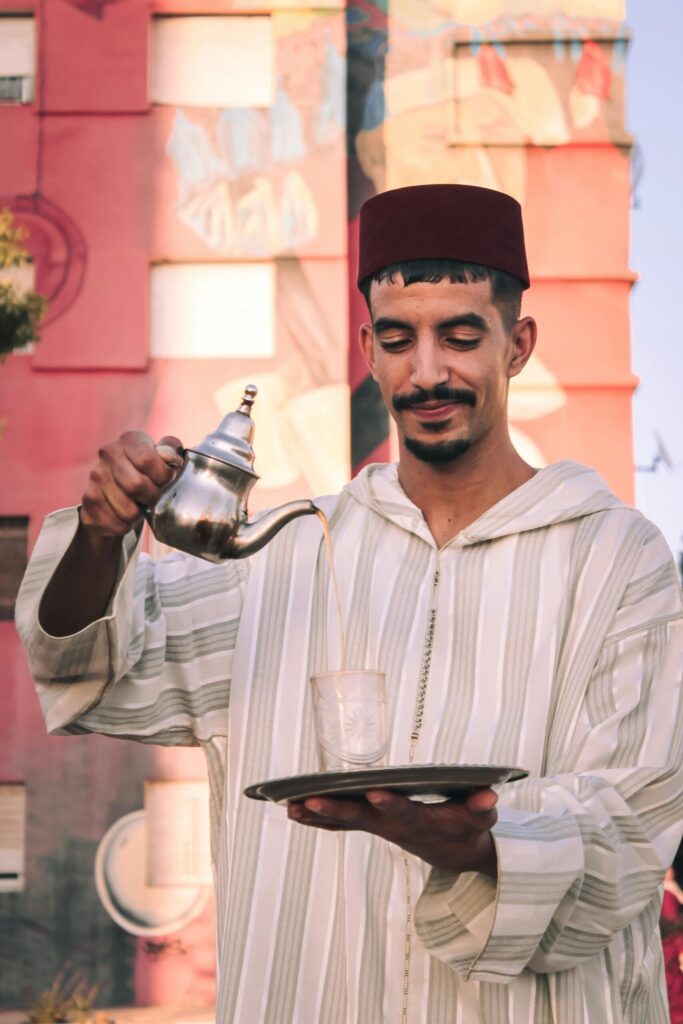
The djellaba across the cultures of the Maghreb
The djellaba is the DNA of Morocco, but it can also be found in Algeria and Tunisia, with a few differences. In Morocco, it is part of everyday life, worn everywhere, even on big occasions. In Algeria and Tunisia, it keeps a more traditional image, reserved for celebrations or ceremonies. What changes? The cut, the decorations, the choice of fabrics… For example, the famous pointed hood is truly the Moroccan hallmark; elsewhere, it is sometimes more discreet, or even absent. And it’s not just about style: the hood protects from the sun, the wind, the sand… It even gives a slightly mysterious air, even on a clear blue-sky day! Each region adapts the djellaba to its way of life, but everywhere, it remains a practical garment full of meaning.
Djellaba for women: styles, cuts and occasions
The women’s djellaba has changed a lot in recent years. Today, there is something for every taste: from the very traditional model to the very modern version. Designers are never short of ideas and offer djellabas for every wish and every situation. Materials vary too: lightweight cotton, linen, silk, velvet… it all depends on the season or the event. When it comes to colors and patterns, there is plenty to choose from: understated, bold, pastel, embroidered or with refined details. Cuts range from ultra-loose to slightly more fitted shapes, to give the whole thing a modern touch. The women’s djellaba suits festive evenings as well as ordinary days, and pairs easily with accessories. In short, it is THE garment that is both practical and stylish.
Moroccan djellaba for women: features and trends
The Moroccan djellaba for women has a style all its own: fine embroidery (often handmade), colors ranging from bright to pastel, and fabrics chosen for their comfort (linen, silk, cotton…). Recent designs dare to use original patterns, fitted or flared cuts, and sometimes discreet pockets for practicality. Some are true ceremonial outfits, perfect for weddings, celebrations or large family gatherings. Others, simpler, are designed for everyday wear. Current trends? Meticulous finishes, embroidered trims (the famous sfifa), decorative buttons… The Moroccan women’s djellaba manages to blend tradition and modernity, offering a wide choice for every occasion.
How to choose your women’s djellaba according to the occasion?
To choose a djellaba for women, you mainly need to think about the occasion:
- Celebration or ceremony: opt for embroidered models, with trim, beads, in fine fabrics (velvet, silk…).
- Prayer or everyday use: go for simplicity, with cotton or linen, easy to wear and care for.
- Cut: loose for freedom of movement, slightly fitted if you like a modern touch.
- Length: not too short (it spoils the effect), not too long (it gets in the way).
- Finishes: take a close look at the quality of the stitching, embroidery, buttons…
- Color: choose a shade that suits you; neutral tones always work.
A little tip: try it on before you buy, to be sure the djellaba hangs well on you.
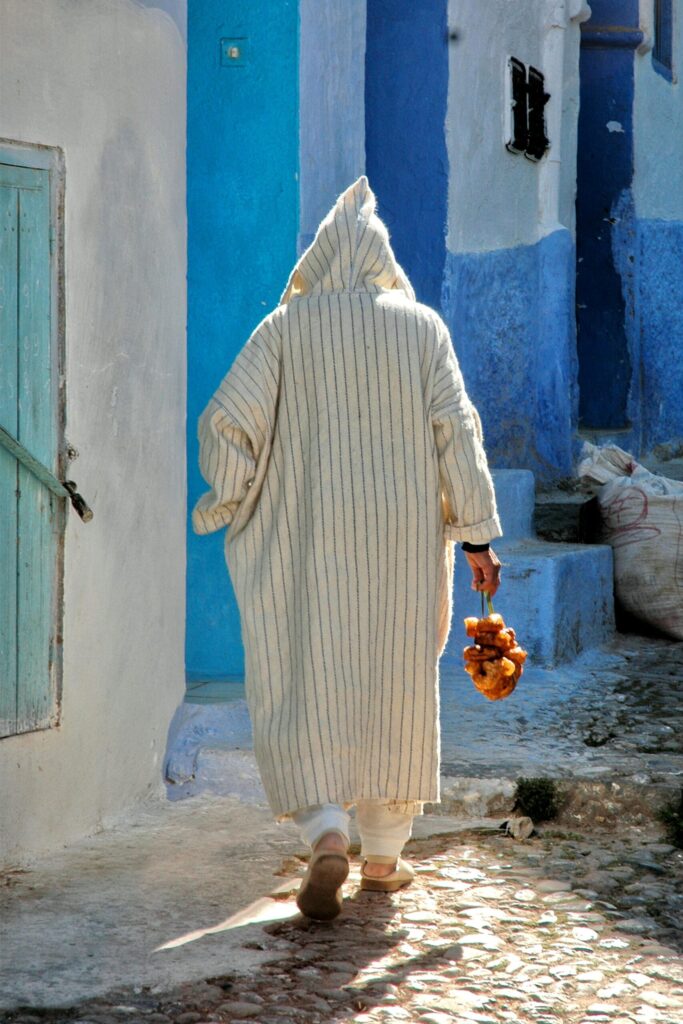
Djellaba for men: tradition and modernity
The djellaba for men keeps its original spirit, but it also evolves with the times. The basics remain: loose cut, hood, long sleeves. After that, it’s all about the details: depending on the region or the trend, you find different fabrics and finishes. For winter, thick wool is ideal; for summer, lightweight cotton is the way to go. As for colors, it often stays with understated tones (gray, beige, navy blue) with occasional stripes or discreet embroidery. The djellaba for men is worn everywhere: prayer, outings, important events. It can be worn on its own or with traditional accessories such as babouches. Modern models sometimes add pockets or wooden buttons for practicality. In the end, it’s a garment that has it all figured out: it adapts to every season, stays elegant and never goes out of style.
The different styles of djellaba for men
- Traditional: wool or thick cotton, perfect for cool days.
- Modern: lighter fabrics, understated colors, clean design.
- Prayer special: simple cut, comfortable fabric.
- For special occasions: fine embroidery, decorative buttons, embroidered trim.
- Vertical stripes to elongate the silhouette, subtle patterns for a touch of originality.
- Depending on the region: length, a more or less pronounced hood, a more or less loose cut.
This wide choice lets everyone find the djellaba that suits them, somewhere between tradition and a contemporary touch.
Tips for wearing a men’s djellaba well
To wear a men’s djellaba well, remember to:
- Choose a loose cut to stay comfortable.
- Avoid styles that are too tight, which have little to do with the original spirit.
- Opt for a neutral color for a classic look (beige, gray, navy blue).
- Pair it with babouches for a traditional style, or with simple sneakers for a modern touch (yes, that works too!).
- Adjust the length to your height: too long is awkward; too short loses its charm.
- If you like, add a thin belt or a scarf to personalize the outfit.
The goal? To be comfortable, elegant, and to find the right balance between tradition and personal style.
Difference between djellaba, abaya, caftan and gandoura
It’s not always easy to find your way among all these traditional garments. Yet each piece has its own codes, its own history, its own cut. Knowing how to tell them apart means better understanding the richness of the North African and Middle Eastern wardrobe. Let’s break it down, simply.
Comparison table of traditional garments
| Garment | Cut | Hood | Main use | Origin |
|---|---|---|---|---|
| Djellaba | Loose, long | Yes | Everyday, celebrations, prayer | Maghreb |
| Abaya | Loose, long | No | Everyday, religious | Middle East |
| Caftan | Loose or fitted | No | Celebrations, ceremonies | Maghreb, Turkey |
| Gandoura | Straight, sleeveless | No | Everyday, summer | Maghreb |
This table is your cheat sheet so you never mix them up again: hood, cut, use, origin… it’s all there. The djellaba stands out for its hood and its versatility, the abaya relies on simplicity, the caftan on the refinement of special occasions, and the gandoura on comfort when it’s hot.
When to wear one or the other?
Each garment has its moment:
- Djellaba: ideal every day, for prayer, or for celebrations, thanks to its comfortable cut and its hood.
- Abaya: mostly worn in the Gulf countries, for religious modesty, when going out or at religious events.
- Caftan: reserved for special occasions, weddings, ceremonies, dressy evenings.
- Gandoura: perfect for summer or for staying at home, when you just want to be comfortable.
In short, the context, the season, and your own preferences make the difference. Tip: avoid the caftan for running errands… unless you like being noticed!
How to choose and care for your djellaba?
Choosing a djellaba isn’t rocket science, but there are a few points not to overlook: fabric, cut, size, use. And to make it last, you also need to care for it properly. Here is practical advice for making the right choice and keeping your djellaba in top shape.
Fabrics, sizes and finishes to favor
- Fabric:
- Winter → wool or thick cotton, for warmth.
- Summer → linen or lightweight cotton, to stay cool.
- Size: loose, but watch the length (too long and you step on it; too short and it loses its look).
- Finishes: check the seams (neither loose nor uneven), the quality of the embroidery, the sturdiness of the buttons.
- Fabric: soft to the touch, pleasant on the skin, flawless.
- For everyday wear: favor simplicity and durability.
- For special occasions: dare to choose fine fabrics and carefully crafted details.
One last point: try on the djellaba before buying to see how it hangs on you.
Care tips to preserve your djellaba
To keep your djellaba looking beautiful for a long time:
- Hand wash or machine wash, but on a delicate cycle with a gentle detergent.
- Avoid the dryer: prefer air drying, in the shade to preserve the colors.
- Iron at a moderate temperature, especially for embroidered models or delicate fabrics.
- For wool, dry cleaning is often recommended (nobody likes felted djellabas!).
- Store it on a hanger to keep its shape and avoid creases.
Regular care is the key to keeping your djellaba impeccable, season after season. And always read the care label, to avoid unpleasant surprises.
Where to buy a quality djellaba?
Between artisan shops, specialty stores and online sites, there is plenty of choice. But not all djellabas are equal: you need to know where to look and which criteria to rely on so you don’t make a mistake. We’ll guide you.
Handcrafted vs. industrial djellaba: which to choose?
- Handcrafted djellaba:
- Made by hand, often in Morocco.
- Natural materials, impeccable finishes.
- Each piece has its own unique little character.
- More expensive, but far more authentic and durable.
- Industrial Djellaba:
- Mass-produced, with more affordable prices.
- Quality varies depending on the manufacturer.
- Good enough for everyday use, as long as the fabric and seams hold up.
For everyday wear, an industrial model can be enough; for a special occasion, handcrafted really makes the difference, whether in beauty or in longevity. It’s up to you, depending on your budget and how you’ll use it.
Criteria for recognizing a good djellaba
To spot a quality djellaba, remember to:
- Check the seams: they should be even and sturdy, with no loose threads.
- Feel the fabric: it should be soft and pleasant, with no defects.
- Look at the hood, the embroidery, the buttons: everything should be securely attached, with no sloppiness.
- Make sure the djellaba keeps its shape after several washes and doesn’t bleed color.
- Take the seller’s reputation into account, whether in a store or online.
- Try on the djellaba if possible, to see the cut and the comfort.
- Read customer reviews, ask for advice… it helps avoid disappointment.
A good djellaba is an investment that lasts. Take the time to choose well!
Conclusion
The djellaba is not just a garment. It’s a true symbol, a heritage, and a style choice. It accompanies every moment, from everyday life to major occasions, and suits every personality. Whether you lean toward tradition or are tempted by modernity, there’s sure to be a djellaba for you. Take the time to choose it, take good care of it, and above all, wear it proudly.
FAQ
The djellaba is not reserved for religious use. It is worn for prayer, but also for everyday wear or during celebrations. How it is worn varies according to traditions and regions.
The djellaba has a hood and comes from the Maghreb. The abaya, which has no hood, is more common in the Middle East. Both are loose-fitting, but their origin and style are not the same.
It is a long, loose-fitting hooded tunic, worn by both men and women in the Maghreb. It comes in a classic or modern version, for every occasion.
For women: embroidered, colorful, silk or cotton styles. For men: understated cuts, thick or lightweight fabrics, sometimes striped or embroidered. And there are also djellabas for children.
Wash it by hand or in the machine on a delicate cycle. Air dry and iron on low heat. For wool or embroidery, dry cleaning is preferable. Good care is the guarantee of a djellaba that stays beautiful.