


Starting the prayer in Islam can feel a little intimidating at first, but in reality, everything is logical and accessible. Here, we move forward calmly, step by step. You will find clear movements, explained words, and practical tips to get started without stress. Everything is here to help you understand, practice and feel at ease.
The steps of prayer in Islam
The salat is truly the heart of Muslim practice. Each prayer follows a very precise order, from the very beginning to the end. We lay the groundwork together so that everything becomes simpler.
Preparing for prayer: ablutions, clothing, intention
Before praying, there are a few steps to follow so that everything is in order:
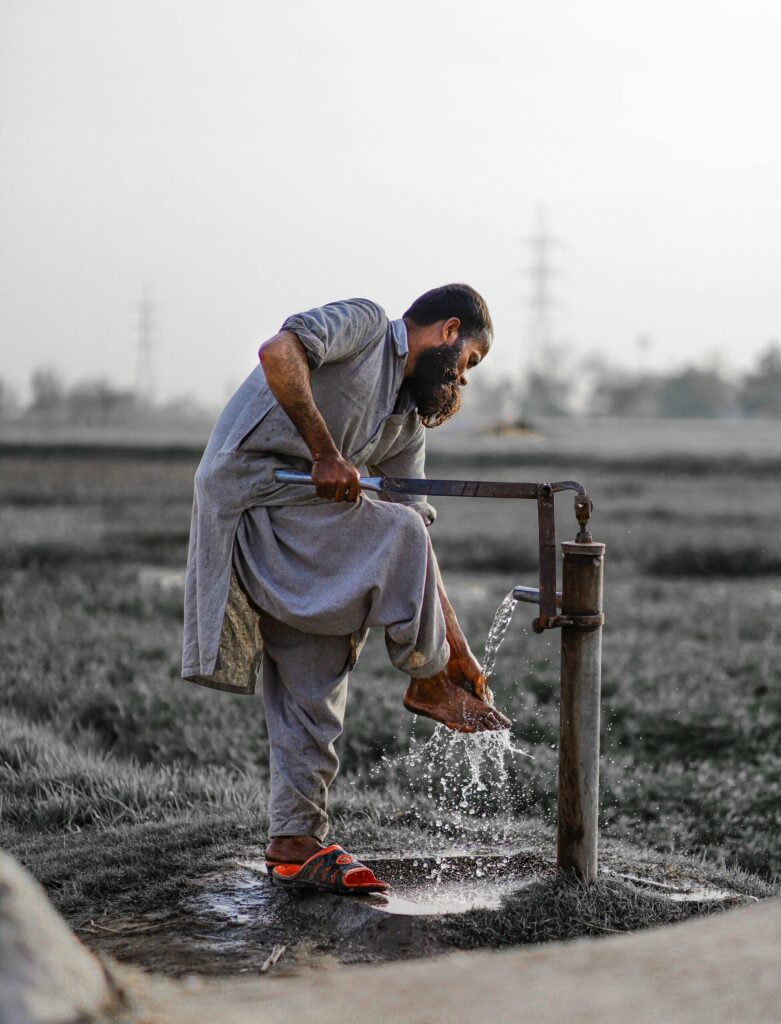
Ablutions (wudu):
- Wash your hands, mouth, nose, face, and arms up to the elbows, pass your wet hands over your head, clean your ears, then finish with your feet up to the ankles.
- Everything is done in order, without rushing. The idea is to be clean and ready.
- No water at hand? Tayammum (with clean earth) takes over when needed, especially if you are ill or traveling.
Clothing:
- It must be clean and cover what is required.
- For men: at a minimum from the navel to the knees, and it is recommended to cover the shoulders as well.
- For women: the whole body except the face and hands.
- Loose clothing is often more comfortable for moving.
Intention (niyya):
- There is no need to say it out loud; it is an inner intention.
- You remind yourself in your heart of the prayer you are about to perform.
- This brief moment before beginning helps you focus.
All of this is the foundation for starting in calm and concentration.

Prayer times and types (Fajr, Dhuhr, Asr, Maghrib, Isha)
Five prayers mark the rhythm of the day, each at its own time. Here is how they are distributed:
| Name of the prayer | Time of day | Number of units (rak’a) |
|---|---|---|
| Fajr | At dawn | 2 |
| Dhuhr | Midday | 4 |
| Asr | Afternoon | 4 |
| Maghrib | At sunset | 3 |
| Isha | At night | 4 |
- The times change every day, depending on the position of the sun.
- Dedicated apps or calendars are handy so you don’t miss the right time slot.
- Direction of prayer: always toward Mecca (qibla).
- The number of rak’a varies, but the structure stays the same.
- There are also additional (voluntary) prayers to go further in spirituality.
Tip: set a reminder on your phone if needed. With a little practice, regularity becomes natural.
How to perform the Muslim prayer step by step
Let’s now move on to the precise sequence of the prayer. Every posture counts, and every word matters.
The movements: standing, bowing, prostration, sitting
Each unit (rak’a) of the prayer follows a sequence of very precise movements:
1. Standing (qiyam):
- Stand upright, feet slightly apart.
- Look at the spot where you will place your forehead.
- The hands rise to ear level (for men) or shoulder level (for women), then rest on the chest or upper stomach.

2. Bowing (ruku’):
- Bend forward.
- Back straight, hands on your knees, eyes toward the ground.

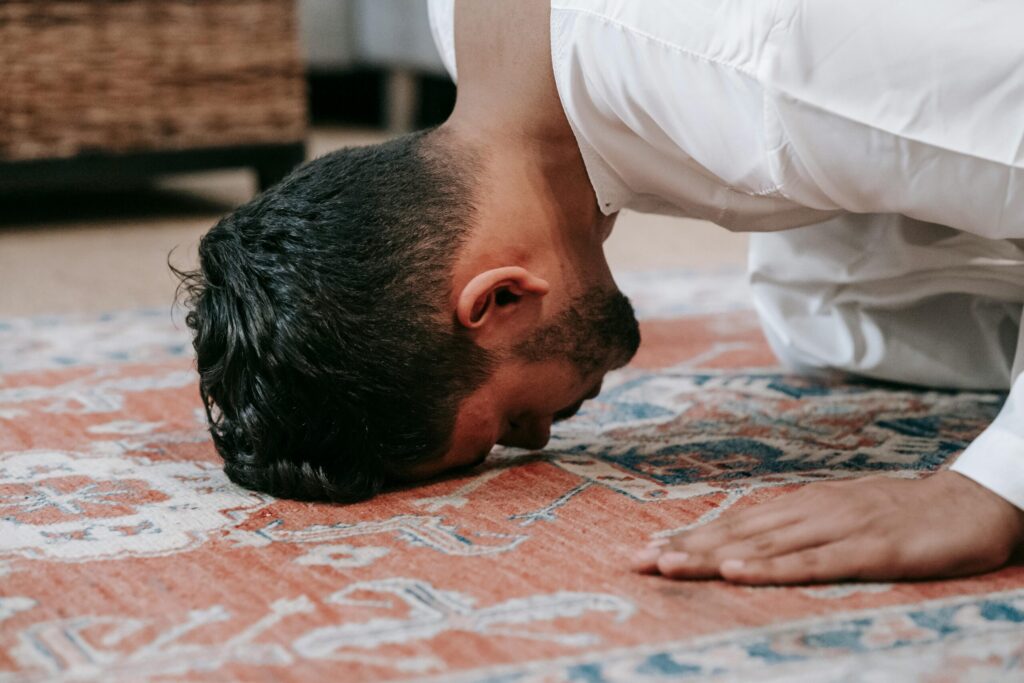
3. Prostration (sujud):
- Place your forehead, nose, palms, knees and toes on the ground.
- Your elbows stay slightly apart.
- This moment is truly the highest connection.
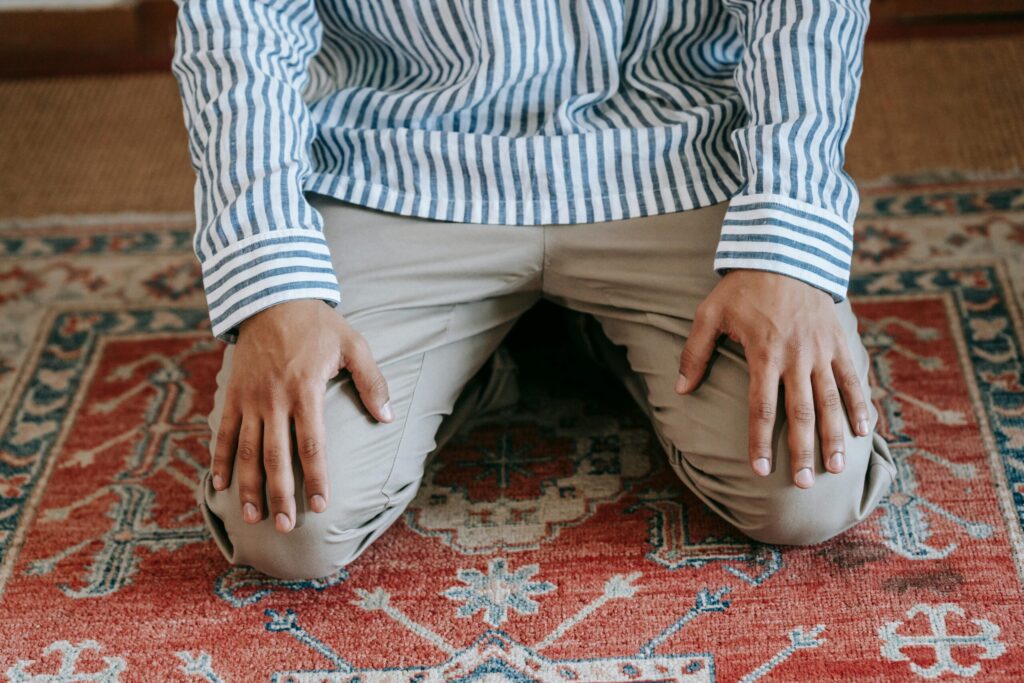
4. Sitting (juloos):
- Sit on your legs, hands on your thighs, back straight.
- A short pause before starting a new unit or finishing.
If you have trouble holding certain positions, you can adapt. The order and the intention remain the key points. And between us, these movements are also a mini warm-up for the body.
What should you say during each step of the prayer?
For each posture, there are specific words to say, in Arabic. Here is the main thing to remember:
- Standing (qiyam):
- You begin with: “Allahu Akbar” (God is the greatest).
- Then, the surah Al-Fatiha, followed by another surah or a few verses.
- Bowing (ruku’):
- Say: “Subhana Rabbiyal Azim” (Glory to my Lord, the Most Great), three times.
- Prostration (sujud):
- Say: “Subhana Rabbiyal A’la” (Glory to my Lord, the Most High), three times as well.
- Sitting (juloos):
- In the last unit, recite the “Tashahhud” (declaration of faith and greetings).
Before you begin, a short invocation can help you settle. The prayer always ends with “Assalamu alaikum wa rahmatullah”, first to the right, then to the left. In the beginning, keep a cheat sheet or listen to recordings. You will see, it comes quickly with practice.
Learning Islamic prayer as a beginner
When you are just starting out, everything seems new. Here is how to move forward gently, without putting pressure on yourself.
Tips for getting started
- Take your time: Start with the movements, then add the words.
- Visual aids: Photos, videos, diagrams… anything that can help you memorize.
- Repeat in a low voice: The accent comes with time, what matters is to try.
- Pray with other beginners: You learn better together, and it is more motivating.
- Be kind to yourself: Mistakes are normal. What matters is making progress.
- Track your progress: A small checklist or a notebook helps you keep going.
- Ask for advice: Experienced people or groups can really help.
Small bonus: if you make a mistake, keep smiling! Perseverance is your best ally.
Common mistakes to avoid
- Forgetting the intention: Even if it is silent, it makes all the difference.
- Skipping a step: Each movement matters. Take the time to learn them in order.
- Getting the order wrong: A visual memo helps you avoid getting lost.
- Talking or losing focus: Cut out distractions, even if it is not always easy.
- Confusing the prayers: The times and the number of rak’a change. A chart or an app, and you’re all set.
If a mistake happens, calmly pick up where you left off. Nobody is perfect, even the most experienced started out just like you!
Practical resources for praying in Islam (PDF, images, audio)
To make learning easier, there are plenty of resources that can support you in your daily life.
Downloadable cheat sheet (PDF)
A summary sheet in PDF format is handy to keep within reach. It details everything you need so you don’t forget anything:
- Diagrams of the different postures (standing, bowing, prostration, sitting)
- Order of the movements, step by step
- Words to recite, in Arabic and in English
- Chart of the times and the number of rak’a for each prayer
- Tips for memorizing more easily
Display it in your prayer corner, slip it into a notebook, or share it with others. It’s a real reference point, especially in the first few weeks. Personalize it with your own notes if needed.
Download here: prayer and ablutions
Videos and audio for practice
When it comes to learning, nothing beats a visual or audio example:
- Step-by-step videos: Each movement shown clearly, with explanations.
- Recitation audio: To practice pronunciation and rhythm.
- Mobile apps: Prayer time reminders, audio guides, checklists, and even quizzes for practice.
- Podcasts and playlists: To listen to while commuting or in the evening, to review without even thinking about it.
Tip: a short audio in your ears just before going to sleep, and memorization almost happens by itself. And if a movement escapes you, a short video can unlock everything in a flash.
Conclusion
Learning prayer in Islam is really a matter of steps. There’s no need to master everything at once. What matters: understanding the movements, practicing regularly, and relying on the right tools. Whatever your level, this guide gives you everything you need to move forward with confidence, at your own pace.
FAQ
Follow the order of the movements (standing, bowing, prostration, sitting), recite the words at each step, and keep a sincere intention. Visual or audio aids are there to help you if needed.
Start with the ablutions, put on clean clothes, and form your intention inwardly. Then follow the sequence of movements and recite the appropriate phrases for each posture.
You recite Surah Al-Fatiha, another surah or a few verses, then specific phrases for each posture (“Subhana Rabbiyal Azim”, “Subhana Rabbiyal A’la”, Tashahhud…).
Take it slowly. Learn the movements first, then the words. Guide sheets, videos or apps are there to help you. Above all, don’t hesitate to ask for advice.
The main steps and the words are the same. There may be a few differences in hand placement or posture, depending on certain schools of thought, but what matters most is the order and the intention.
To make progress, remember to check out the PDF, video and audio resources provided. Prayer is also a matter of consistency: every day, you move forward a little more.