


The qamis is quickly associated with Muslim culture. Yet it is not a religious garment required by Islam. It is first and foremost a traditional men’s outfit, known for its simplicity and modesty. Tradition and religion are often confused, so it’s worth clarifying where the qamis comes from and what it really means.
In short:
- The qamis is a traditional garment, not a religious obligation.
- It symbolizes modesty and simplicity in Muslim culture.
- Wearing it is a matter of tradition, not a religious prescription.
- It differs from other garments such as the djellaba or the abaya.
Origin and meaning of the qamis
The qamis is a traditional men’s garment originating from the Arabian Peninsula and worn for centuries in many Muslim countries. It embodies simplicity, modesty and attachment to tradition, without being a religious garment required by Islam.
In practice, the qamis – also called thawb or dishdasha depending on the region – holds a central place in traditional dress. Its long, straight cut, free of frills, emphasizes discretion and humility. This garment has adapted over time to meet everyday needs: it protects from the sun, lets air circulate, and allows free movement. It is chosen for comfort, for the climate, but also out of respect for local customs.
In many families, wearing the qamis also means continuing a regional or family tradition. The cut, color and details vary from region to region and mark the identity of the wearer. Even though it is often linked to the religious sphere, the qamis remains above all a cultural marker, a testament to the diversity of clothing traditions in the Muslim world.
History of the qamis and how it has evolved over time
The qamis has its roots in the Arabian Peninsula, and it existed well before Islam. Originally, it was a practical garment, designed to cope with the sun and heat. With the arrival of Islam, the qamis traveled to many Muslim countries, keeping its strengths: simplicity, sobriety, comfort. Fabrics, colors and styles have evolved over time, but it remains a strong symbol of cultural identity in many Muslim societies.
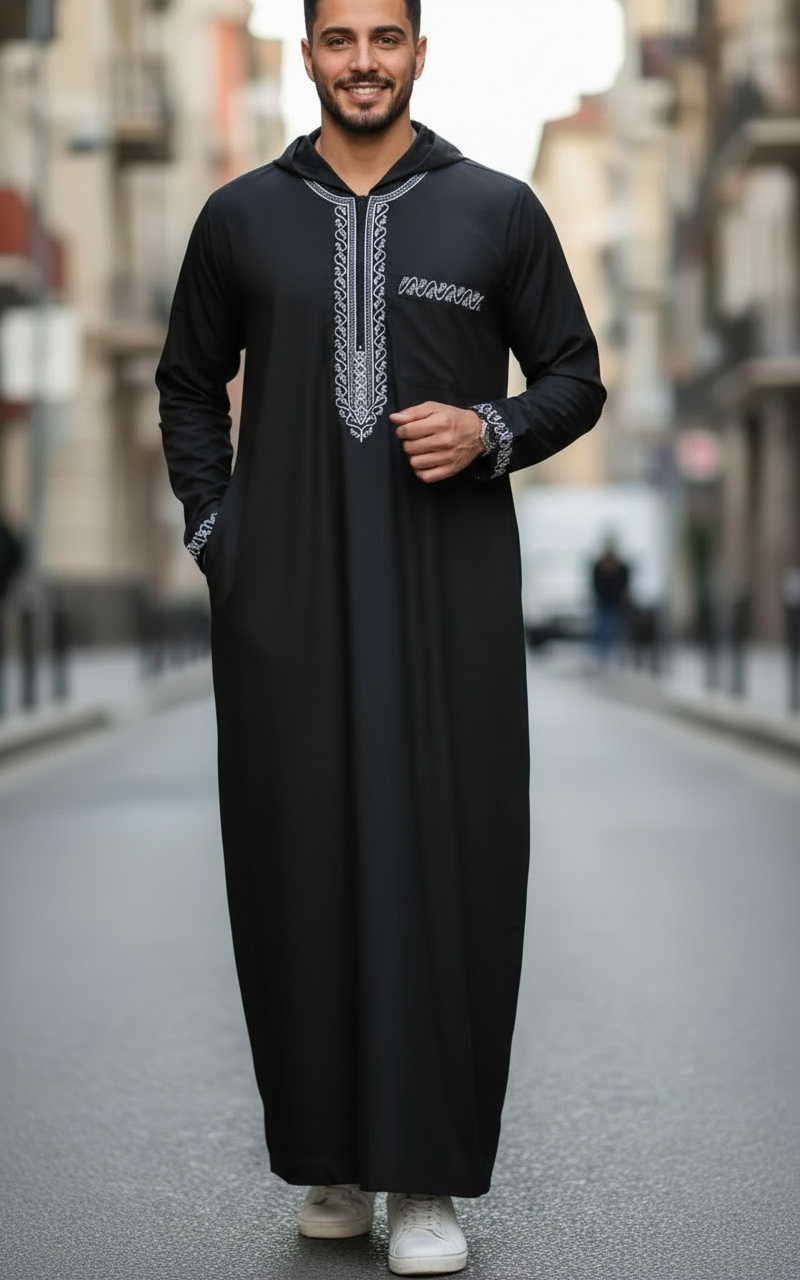
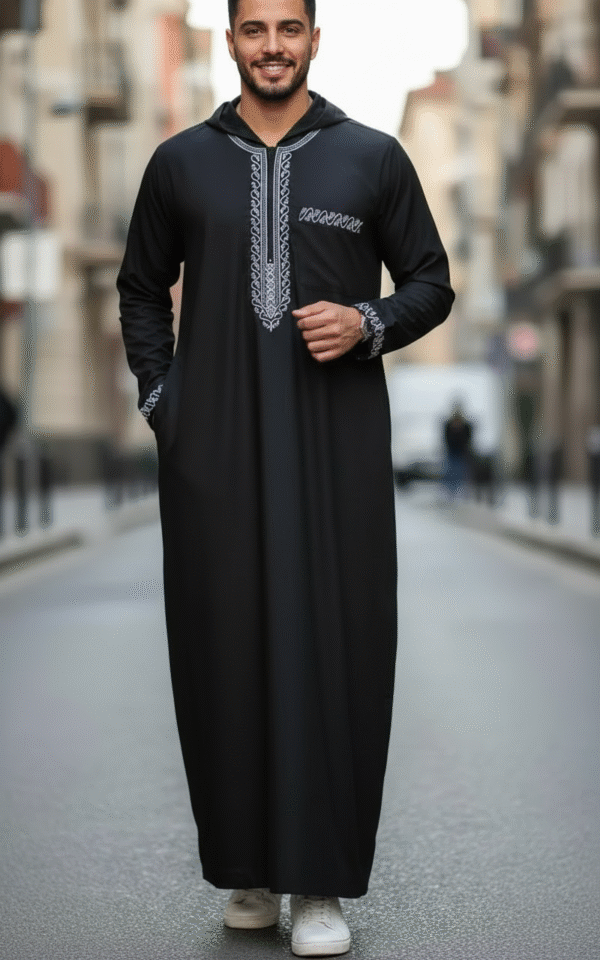
Over the centuries, the qamis has proven able to adapt. Fabrics have gone from raw cotton or linen to modern materials, sometimes synthetic. Colors, once natural, have diversified according to tastes and occasions. In some countries, the qamis is adorned with embroidery or decorative buttons for celebrations and ceremonies. But its purpose remains the same: to offer a comfortable garment, suited to the climate, and faithful to modesty. It is a perfect example of a garment that withstands the ages without losing its essence.
Cultural and social symbolism of the qamis
The qamis conveys values such as modesty, simplicity, and respect for traditions. It often points to a modest way of life and attachment to family or tribal roots. Wearing the qamis can also show a desire to stand apart from Western influences or to display belonging to a community. But this symbolism is first and foremost cultural and social, with no mandatory religious value.
Beyond the garment itself, the qamis plays a real role in the building of collective identity. It allows people to affirm a connection to a region, a social group, or even to express cultural pride. Depending on the setting, wearing the qamis daily or at special events is also a way of preserving a traditional way of life in the face of modernity. It is sometimes worn out of respect at ceremonies or official gatherings. And it is often passed down from generation to generation, reinforcing this role of memory and social cohesion.
-
-14 %

Qamis Men's Hooded Sweatshirt
Original price was: 34,80 €.29,88 €Current price is: 29,88 €.Select options This product has multiple variants. The options may be chosen on the product page -

Men's Qamis with embroidery and hood
30,00 €Select options This product has multiple variants. The options may be chosen on the product page -
-28 %

Qamis men's hooded – Long casual sweatshirt
Original price was: 42,00 €.29,88 €Current price is: 29,88 €.Select options This product has multiple variants. The options may be chosen on the product page



The qamis in the Muslim religion
The qamis is not a mandatory religious garment in Islam, but it is appreciated for its conformity to the principles of modesty recommended by the religion. Wearing it remains a personal or cultural choice, not a religious prescription.
In Islam, modest dress is recommended, but no specific garment such as the qamis is required. The Prophet Muhammad wore the clothing of his time, including the qamis, but he never required this garment for everyone. Today, some choose the qamis to follow the Prophet’s example or out of cultural preference, but it remains a personal choice.
Islam emphasizes intention and decency, not the exact form of the garment. A Muslim can perfectly well respect religious principles with other garments, as long as they are modest. The qamis, with its loose cut and length, naturally meets these criteria, which explains its popularity. But it has no particular religious status. It is one option among others, and everyone chooses according to their culture, habits or comfort. In short, no pressure.
Is the qamis mandatory according to Islam?
No, the qamis is not mandatory according to Islam. The religion simply asks that people dress modestly, that is, cover the body decently, without imposing a specific style. Wearing the qamis is therefore a possibility among others, depending on each person’s customs or preferences.
This freedom in dress creates a great diversity of styles across the Muslim world. For example, in Asia or Africa, other traditional outfits serve the same purpose as the qamis while respecting modesty. What matters most is the intention to remain decent, not the shape of the garment. The qamis is above all a matter of culture and context, not a universal religious rule.
Differences between the qamis, djellaba, abaya and other garments
Several traditional garments exist in the Muslim world, each with its own characteristics:
- Qamis: long, straight tunic for men, without a hood, often white or light-colored.
- Djellaba: loose hooded robe, typical of North Africa, worn by both men and women.
- Abaya: long black women’s robe, especially in the Gulf countries.
- Gandoura: loose tunic, often sleeveless, from North Africa.
Each garment has its own cut, use and symbolism. The djellaba is very common in Morocco and Algeria, the abaya is emblematic in Saudi Arabia and the Gulf, and the qamis is popular across the Arabian Peninsula. All of them meet specific needs: climate, tradition, social appropriateness. But they share two essential points: modesty and simplicity, two key values of Muslim culture.

When and by whom is the qamis worn?
The qamis is worn by men of all ages, especially in Arab and Muslim countries, in everyday life or at religious or cultural events. It is not reserved for religious figures or imams.
Depending on the region and the occasion, the way the qamis is worn changes. In some countries, it is the everyday outfit; elsewhere, it comes out for religious holidays, Friday prayers or major family events. You don’t need to be a religious figure to wear it: ordinary men, young or old, adopt it for comfort, tradition or simply out of taste.
The variety of uses of the qamis shows the richness of Muslim cultures. In the Gulf, it is common to see men in a qamis at the office, at school or on casual outings. Elsewhere, it signals respect at ceremonies. It also adapts to the seasons: lightweight fabrics for summer, lined versions for winter. This garment spans generations, from children to elders, and it is not unusual to see an entire family in qamis on big occasions. Simple and accessible, it stands out as a universal garment in many contexts.
Occasions and contexts for wearing the qamis
- Daily life: in many Gulf countries, the qamis is the standard outfit for work, school or the market.
- Religious events: often worn for prayers, on Fridays, during Ramadan or for holidays such as Eid.
- Ceremonies and celebrations: weddings, family gatherings, special occasions.
- Travel or pilgrimages: some choose the qamis for comfort during Hajj or Umrah.
Besides all that, it is also worn for visits to loved ones or outings with friends. The choice of the qamis may come from respect for social norms or from the desire to show attachment to tradition. In big cities, it coexists with more Western clothing, proof of its ability to evolve. Practical, its loose cut allows free movement, making it an everyday ally.
Modern qamis: styles, fabrics, colors
Today, the qamis comes in a wide variety of styles, fabrics and colors. Classic versions are often white or beige, but there are now colorful qamis, embroidered ones, and versions in cotton, linen or synthetic fabrics. Some remain understated, others are more decorated, depending on tastes and occasions. This diversity proves that the qamis is a living garment, very much of its time.
Designers now offer:
- fitted or classic cuts,
- different types of collars (mandarin, round, officer),
- refined details such as embroidery or crafted buttons,
- suitable fabrics: light cotton for summer, thicker fabrics for winter, modern blends for easy care,
- a color palette: white for purity, understated tones for everyday wear, bright colors or ornaments for celebrations.
Everyone can therefore find a qamis to their liking, for every use. In short, the qamis knows how to reinvent itself while keeping its DNA.

Qamis, tradition or religion? Comparison table
The qamis is above all a traditional Muslim garment, even though it is sometimes associated with religion. This table clarifies the difference between the religious and cultural aspects of the qamis.
| Criterion | Tradition (qamis) | Religion (Islam) |
|---|---|---|
| Origin | Arabian Peninsula | Religious texts (Quran, Sunnah) |
| Obligation | No | No (only modesty is required) |
| Symbolism | Simplicity, modesty, culture | Modesty, humility |
| Context of wear | Daily life, celebrations, prayer | Not limited to a specific garment |
| Reserved for an elite? | No | No |
| Spiritual value | Not specific | Depends on the intention |
This table helps keep things from getting mixed up. The qamis is first and foremost a matter of culture. Islam, for its part, emphasizes modesty, not a specific garment. So, no hidden superpower in the qamis, promise! It is a traditional garment that can accompany religious practice, but it is never an obligation.
Conclusion
The qamis is first and foremost a traditional men’s garment, rooted in the culture of Muslim countries. It is not a religious garment imposed by Islam, even though it often accompanies religious practice thanks to its simplicity and modesty. Wearing the qamis remains a personal or cultural choice, never a religious obligation. Understanding this nuance means avoiding conflations and better respecting the diversity of dress in the Muslim world.
FAQ
The qamis is not mandatory in Islam. It is worn out of tradition or preference, but the religion simply asks for modesty in dress, without imposing a specific garment.
This nuance helps avoid a lot of confusion. In many Muslim countries, other garments serve the same purpose as the qamis while respecting the religion. Everyone is therefore free to choose their outfit, as long as modesty is respected. The result: a true diversity of dress, reflecting the richness of Muslim cultures.
The qamis is a long tunic for men, the djellaba is a loose hooded robe from North Africa, and the abaya is a women’s robe worn mainly in the Gulf. Each has its own origin and function.
Also worth remembering: the djellaba has a hood and wide sleeves, the abaya is black and hoodless, and the qamis stands out for its simplicity and is worn mostly on the Arabian Peninsula. These differences come from how garments adapt to the climate, customs and regional traditions.
Yes, the qamis can be worn by anyone, regardless of religion. It is not reserved for religious use, but it is best to respect the cultural context.
Out of respect, find out about local customs before wearing the qamis at ceremonies or in countries where it carries strong symbolic value. Apart from that, the qamis remains a comfortable and practical garment, appreciated for its cut and its simplicity.
The qamis has no spiritual value of its own in Islam, but it can be associated with modesty and attachment to Muslim tradition.
The spiritual dimension depends mostly on the intention of the person wearing it. For some, it is simply a traditional garment; for others, it symbolizes a personal commitment to values of simplicity and modesty. But in itself, the qamis has no mandatory spiritual meaning.
No, the qamis is worn every day as well as at religious or festive events. It is not reserved for prayer.
In many countries, you see men in qamis at work, at school or out and about. Its versatility makes it a garment suited to all kinds of contexts: religious, social, family.
Leave a Reply