


The Hajj is the great annual gathering of Muslims in Mecca, in Saudi Arabia. The fifth pillar of Islam, it must be performed at least once in a lifetime by every adult Muslim who has the means to do so. This guide explains the steps, the requirements, the cost, the difference from Umrah and all the registration procedures you need to know about.
In brief:
- The Hajj is a mandatory pilgrimage to Mecca, lasting 5 to 6 days on specific dates.
- It follows codified rites and registration is done through the Nusuk platform.
- The average budget is around 5000 to 9000 euros per person.
- The Hajj is distinct from Umrah, which is optional and can be performed year-round.
Definition and meaning of the Hajj
The Hajj is the great annual pilgrimage to Mecca, in Saudi Arabia. It is the fifth pillar of Islam, and every Muslim who has the physical and financial ability must perform it at least once in their lifetime.
But the Hajj is much more than a religious obligation. It is a powerful moment of sharing and brotherhood, where millions of people from all over the world live a unique spiritual experience. Everyone, without distinction, wears the ihram, the two white cloths that symbolize equality before God. The Hajj invites humility, self-reflection, forgiveness and reconnection with one’s faith. It is also a time of solidarity: every pilgrim shares the same gestures and the same prayers, in an atmosphere of complete brotherhood.
Origin and history of the Hajj
The Hajj goes back to the tradition of the Prophet Ibrahim (Abraham), who built the Kaaba with his son Ismail. The rites of the Hajj recall several major episodes of their story, such as the sacrifice or Hajar’s search for water. In the 7th century, the Prophet Muhammad restored the Hajj to its current form, centered on monotheism.
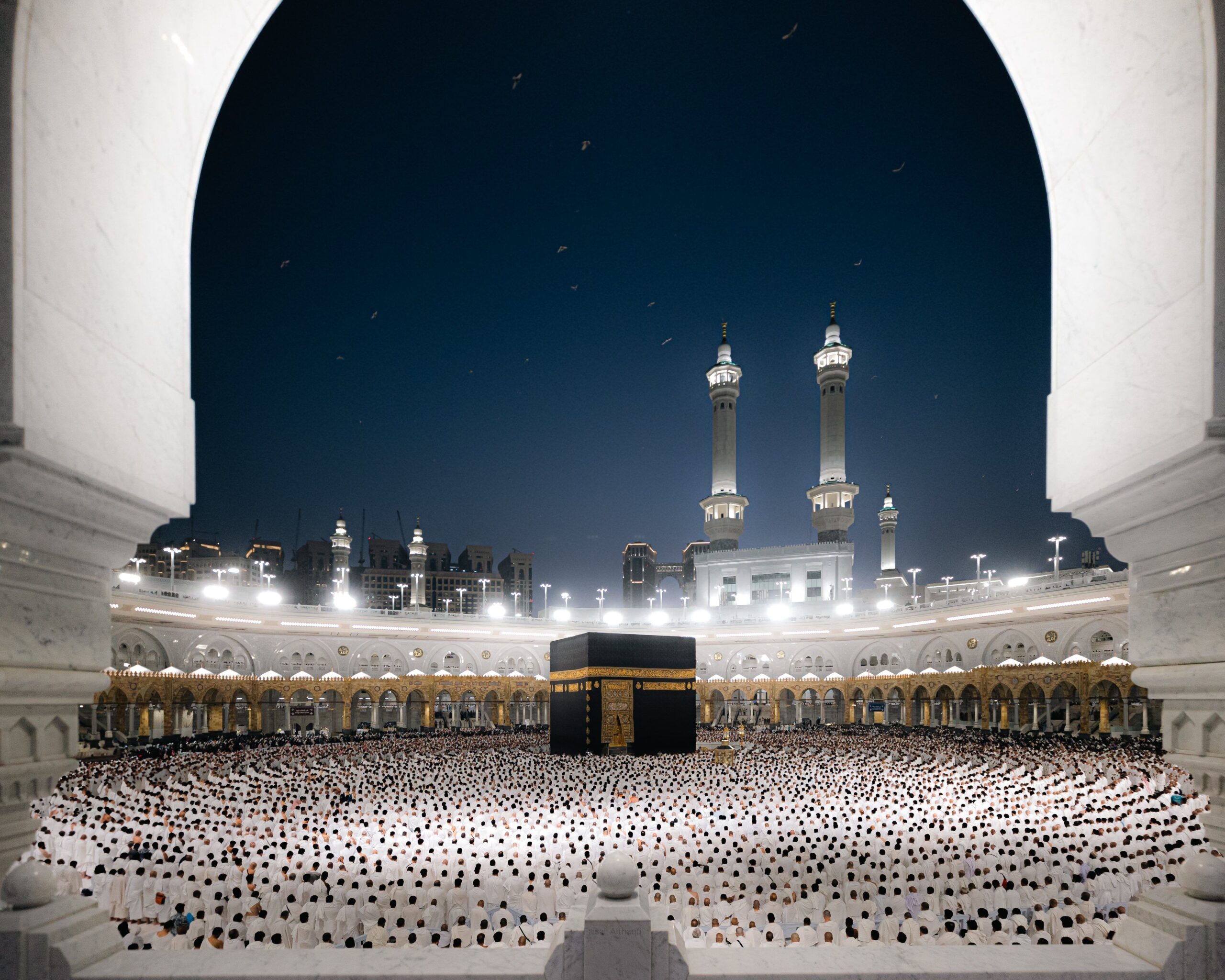
Over time, the Hajj has evolved, but its spiritual foundations have remained. The rituals followed today are very close to those of the Prophet’s time. The Kaaba, at the heart of the sacred mosque, remains the center of the pilgrimage. Each step echoes key moments of the Abrahamic faith, such as the stoning of Satan or the symbolic sacrifice. This continuity gives the Hajj a timeless dimension: every pilgrim joins a tradition that spans the centuries.
Why is the Hajj a pillar of Islam?
The Hajj is one of the five pillars of Islam because it symbolizes submission to God, the unity of Muslims and the fundamental values of the faith. It is prescribed by the Quran and is one of the major duties of the believer.
By performing the Hajj, Muslims express their total commitment to God and their desire to follow the teachings of the Prophet. This pilgrimage allows them to purify their soul, ask for forgiveness and start afresh. On a collective level, it strengthens the sense of belonging to the Muslim community, since everyone performs the same rites, at the same time, in a spirit of equality. The Hajj also highlights the importance of effort, patience and perseverance, qualities that are central to Muslim spirituality.
Dates and duration of the Hajj
The Hajj takes place every year between the 8th and 13th of the lunar month of Dhul Hijjah, the last month of the Islamic calendar. The duration varies from 5 to 6 days depending on the rite followed.
The dates of the Hajj are strictly set by the Islamic calendar, which does not exactly match the Gregorian calendar. Each step takes place at a specific time, which makes preparation essential. Most pilgrims follow a 5 to 6 day itinerary, although some extend their stay on site.
To organize your trip well, it is important to consult an up-to-date Islamic calendar to know the corresponding dates. Planning ahead lets you organize everything calmly and avoid surprises. In short: at the Hajj, timing is everything!
When does the Hajj take place each year?
The Hajj takes place every year from 8 to 13 Dhul Hijjah, the last month of the Islamic calendar. The exact dates change each year in the Gregorian calendar, because the Islamic calendar is based on the moon.
To prepare for your departure, it is advisable to follow the official announcements, which are often published several months in advance. Travel agencies and religious authorities provide the precise corresponding dates each year. This shift also makes it possible to experience the Hajj in different climates, which can affect organization and comfort on site.
How many days does the Hajj last?
The Hajj generally lasts 5 to 6 days, depending on the type of Hajj chosen and the pace of the rites. The vast majority of pilgrims follow the classic 6-day itinerary.
This period includes all the main steps, from entering ihram to the conclusion of the rites in Mecca. Some choose to stay a little longer to pray or visit, but the essence of the Hajj takes place over these few days. Good organization is important, as the sequence of rites can be intense, especially with the heat and the crowds.
Requirements and obligations for performing the Hajj
The Hajj is mandatory for every adult Muslim who is of sound mind, free, and has the necessary physical and financial resources. Administrative and health requirements must also be met.
To be eligible for the Hajj, you must:
- be Muslim
- have reached adulthood
- be in good mental and physical health
- have the means to finance the trip without putting your family in difficulty
In addition, there are administrative procedures (passport, visa, registration) and health requirements (vaccines, medical certificates). The Saudi authorities also set quotas by country to manage the influx.
Physical and spiritual preparation is just as important. The Hajj requires endurance and patience. Remember to check the specific requirements every year, especially regarding public health.
Who can perform the Hajj?
The Hajj is intended only for adult Muslims who are free, of sound mind, and have the physical and financial means. Children and people who are dependent or physically unable are exempt.
These criteria take into account each person’s actual capacity. People who are ill, very elderly or have major constraints may be exempted or represented by a relative (under specific conditions). The goal is not to make the obligation impossible, but to allow everyone to fulfill it when the conditions are met. A visit to the doctor before departure remains a good idea to make sure you are fit to go.
Documents and administrative procedures
To take part in the Hajj, you will need to gather several essential documents:
- Valid passport
- Special Hajj visa
- Vaccination certificate (notably against meningitis)
- Round-trip plane ticket
- Proof of registration on Nusuk
- Proof of residence
- Recent passport photos
- Proof of financial resources
It’s best to plan ahead: check the validity of your passport, book appointments for your vaccines, and prepare all the paperwork well before departure. The Hajj visa is specific, not to be confused with a tourist visa. Nusuk centralizes most of the procedures, but always keep paper and digital copies of your documents. A well-organized file is the key to traveling with peace of mind.
-
Sold out

Men's Ihram 2-Piece Set – Microfibre 700g
£16.44Read more -
Sold out

Men's 2-Piece Ihram – Premium Comfort for Umrah and Hajj
Price range: £16.44 through £22.56Select options This product has multiple variants. The options may be chosen on the product page -
Sold out
Men's 2-Piece Ihram – Polyester Jacquard 1000g
£22.56Read more

Stages and rites of the Hajj
The Hajj includes several specific rites to be performed in Mecca and the surrounding area, over several days. The main stages are: the ihram, the tawaf, the walk between Safa and Marwa, the stays at Mina, Arafat, Muzdalifah, and then the sacrifice.
Each rite has its own spiritual meaning. Pilgrims follow a journey paced by prayers, walks and ritual gestures, in a precise order. Understanding each step well helps you experience the Hajj fully and peacefully.
Preparation is essential: guides, mobile apps, and information sessions with agencies or imams all help you find your bearings. Following the safety instructions, respecting group life and staying alert during the large gatherings at Mina or Arafat is what makes the pilgrimage run more smoothly.
The main stages of the Hajj
| Day | Place | Main rite |
|---|---|---|
| 8 Dhul Hijjah | Mecca / Mina | Entering ihram, departure for Mina, prayers |
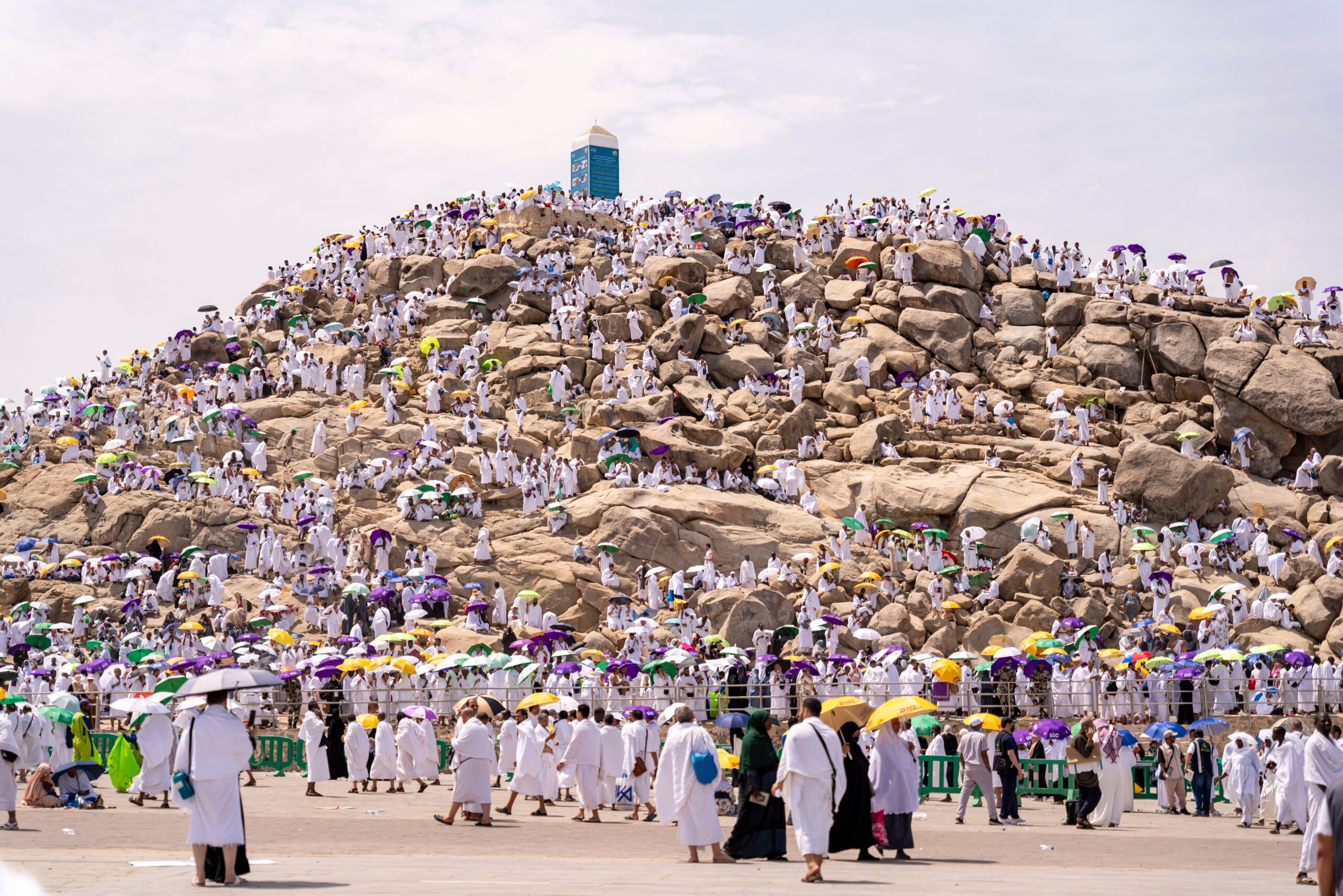
| 9 Dhul Hijjah | Arafat | Standing at Arafat, prayers, contemplation |
| Night of 9-10 | Muzdalifah | Prayer, collecting pebbles |
| 10 Dhul Hijjah | Mina / Mecca | Stoning, sacrifice, shaving, tawaf al-ifadha |
| 11-12 Dhul Hijjah | Mina | Stoning of the pillars, stay at Mina |
| 13 Dhul Hijjah (optional) | Mina / Mecca | Final rites, farewell tawaf (tawaf al-wada) |
Each step has its importance. The ihram marks the start of the pilgrimage with its rules of purity. Arafat is the peak of the Hajj, a high point of prayer. At Muzdalifah, pilgrims collect pebbles for the symbolic stoning of Satan at Mina. The sacrifice recalls the trial of Ibrahim; the shaving or cutting of the hair symbolizes purification. Finally, the farewell tawaf brings everything to a close. For each moment, follow your guide’s instructions and keep the order of the rites in mind.
The 3 types of Hajj (tamattu’, ifrad, qiran)
| Type of Hajj | Description | Umrah included? | Sacrifice required? |
|---|---|---|---|
| Tamattu’ | Umrah then Hajj performed separately, with a break from ihram | Yes | Yes |
| Ifrad | Hajj alone, without a prior Umrah | No | No |
| Qiran | Umrah and Hajj combined, without a break from ihram | Yes | Yes |
The choice of type of Hajj depends on your preferences and your condition. Tamattu’ is the most popular, as it allows you to perform the Umrah before the Hajj with a break in between. Ifrad is simpler, for those who want to focus solely on the Hajj. Qiran, which is more demanding, combines the two without a break. Each option has its own particularities, especially regarding the sacrifice or the duration of the ihram. Ask your agency or a religious guide for advice to choose the best option.
Difference between Hajj and Umrah
The Hajj is a mandatory pilgrimage at a specific time; the Umrah, on the other hand, is optional and can be performed at any time. The two share certain rites, but the Hajj is longer and more communal.
The main difference is the obligation and the date: the Hajj is only possible during a given period, whereas the Umrah can be done whenever you wish. The Hajj requires heavier organization and greater logistics.
On the practical side, the Umrah focuses on a few rites: ihram, tawaf around the Kaaba, walk between Safa and Marwa. It takes a few hours, without the stays at Mina or Arafat. The Hajj, by contrast, involves a longer journey with more steps. The atmosphere is not the same: the Umrah is calmer, while the Hajj means crowds and intensity. Many people perform the Umrah several times, but the Hajj remains an exceptional event.
Key similarities and differences
- Hajj: mandatory; Umrah: optional.
- Hajj: fixed dates; Umrah: all year round.
- Both: in Mecca, with tawaf and sa’i.
- Hajj: 5 to 6 days; Umrah: a few hours.
- Hajj: additional steps (Mina, Arafat, sacrifice).
- Umrah: can be performed alone or before/after the Hajj.
To sum up: the Hajj and the Umrah share a common foundation, but differ in their scope, duration and religious importance. The Umrah is a bit like practice for, or a complement to, the Hajj, but it does not replace it. Each offers a powerful spiritual experience, suited to your means.
Hajj Price and Budget
The price of the Hajj varies depending on the agency you choose, the period and the level of comfort, but you should expect to pay between 5000 and 9000 euros per person, excluding personal purchases.
The budget depends on several factors: choice of agency, type of accommodation, duration, included services (transportation, meals, visits), booking date and the price of plane tickets. Don’t forget administrative fees and on-site expenses (souvenirs, purchases).
Comparing the offers of approved agencies is essential, because services vary a lot. Some packages include visits, meals and guidance, while others focus on the essentials. Also plan a small budget for extras: purchases, gifts or unexpected costs. The earlier you book, the wider the choice and the more stable the prices. A tip: always keep a margin for logistical surprises, the Hajj likes to hold a few in store!
What Influences the Price of the Hajj
- Travel agency (and its reputation)
- Type of accommodation (standard or luxury hotel)
- Length of stay and additional options
- Included services (meals, visits, transfers)
- Booking date (earlier is often better)
- Flight prices and how they change
Other elements also play a role: the hotel’s proximity to the mosque, the group size and the spiritual guidance. Some packages offer French-speaking guides, information sessions and medical assistance. Read the details carefully and ask all your questions before booking.
Examples of Recent Prices
| Package type | Price range (per person) | Included services |
|---|---|---|
| Economy | 5000 – 6000 € | Standard accommodation, flights, transfers |
| Comfort | 6500 – 8000 € | 3-4 star hotel, meals, visits |
| Premium / Luxury | 8500 – 9000 € and more | 5-star hotel, VIP services |
These ranges show the difference between simple comfort and high-end services. Economy offers stick to the essentials, while premium packages focus on rest and comfort – a real plus after long days of rites. Check carefully what is included: meals, transfers, guidance. A hotel close to the holy sites also means less fatigue and more time for the rites.
Hajj Registration Procedure (Nusuk)
Since 2023, French pilgrims must register for the Hajj through the official Nusuk platform, which centralizes all administrative procedures and booking with approved agencies.
Nusuk simplifies registration and ensures compliance with Saudi quotas and rules. You can choose an agency, submit your documents and track your file online.
Its advantages? Transparent offers, secure payments, real-time tracking. Pilgrims compare packages, check availability and receive notifications at every step. This centralization limits the risk of fraud. Be sure to read the terms carefully and keep all the confirmations you receive.
Steps to Register on Nusuk
- Create an account on the Nusuk platform
- Fill out the online registration form
- Upload the required documents (passport, photos, certificates)
- Choose an approved agency and a Hajj package
- Pay online securely
- Receive the confirmation and the electronic visa
- Follow the instructions to prepare for the trip
Each step must be done carefully. Double-check your documents before submitting them. After payment, keep an eye on your emails for the confirmation and the visa. If needed, the Nusuk help section or customer service is there for you. Good administrative organization means one less worry!
Tips for a Successful Registration
- Prepare all documents in advance (passport, vaccines)
- Check the validity of your ID documents
- Compare the offers of approved agencies on Nusuk
- Register as soon as registration opens for more choice
- Read the terms and included services carefully
- Find out about health requirements and travel guidelines
To avoid last-minute stress, put together your file as soon as possible. Taking the time to compare agencies and read reviews from previous pilgrims helps you make an informed choice. Also stay alert to any updates on health or entry formalities, as these can change from one year to the next.
Conclusion
The Hajj is a unique moment in the life of a Muslim, both demanding and unforgettable. Preparation, whether administrative or logistical, is essential to experience this pilgrimage under the best conditions. With the Nusuk platform, the procedures are simpler and safer. Taking the time to learn about each step and each requirement, and managing your budget well, is the key to fully enjoying this spiritual experience.
FAQ
The Hajj is the great annual pilgrimage of Muslims to Mecca, a major religious act and one of the five pillars of Islam.
The Hajj is an obligatory pilgrimage held on fixed dates, while the Umrah is a shorter, optional pilgrimage that can be performed all year round, with briefer rites.
The cost of Hajj depends on the agency and the level of service, but you should generally budget between 5000 and 9000 euros per person.
Hajj generally lasts 5 to 6 days, from the 8th to the 13th of the month of Dhul Hijjah in the Islamic calendar.
Hajj registration is now done through the official Nusuk platform, which centralizes the procedures and bookings with approved agencies.
Leave a Reply