


The breaking of the fast, or iftar, is the moment when everything changes each evening during Ramadan. It’s not just about a meal: there’s a whole atmosphere, a true blend of spirituality, sharing and respect for tradition. But what time should you break your fast? What should you say at the right moment? And how can you make sure you follow the rules? Here is a simple, straightforward guide to experiencing the breaking of the fast without any fuss, day after day.
What is the breaking of the fast (iftar)?
Religious and symbolic meaning
The iftar is not just a bite to eat after a day without food. As soon as the sun sets, Muslims end the fast by following the tradition of the Prophet Muhammad ﷺ. This moment carries real weight:
- It is an opportunity to thank God for the endurance and patience of the day.
- We work on our discipline, day after day.
- Sharing is at the heart of iftar: family, friends, neighbors, and sometimes even strangers – everyone can be invited.
- It is a moment to think of others, especially those who are less fortunate.
- Iftar is not only a meal. It is a true spiritual pause, a time to refocus, reflect on the meaning of Ramadan, and strengthen your connection with God.
In the end, the iftar is as much an act of faith as it is a moment to gather around the table.
Differences between breaking the fast and Eid al-Fitr
There is a clear difference between the nightly iftar and the festival of Eid al-Fitr. Iftar happens every evening of Ramadan, as soon as the sun sets, to mark the end of the day of fasting. Eid al-Fitr is the great celebration that arrives at the end of the holy month:
- Eid begins with a special prayer, followed by a festive meal.
- It is a day of joy, reunions and celebration.
- People give donations (zakat al-fitr), visit family and exchange good wishes.
- Iftar is the daily ritual; Eid is the event that closes Ramadan.
In short, iftar sets the rhythm of the month, and Eid ends it in style.
What time does the breaking of the fast take place?
How to determine the exact time (sunset)
The time for iftar is exactly at sunset, the time of maghrib. To avoid mistakes:
- Wait until the sun’s disk has fully disappeared below the horizon.
- Do not break the fast early, even by a few minutes.
- Use reliable references:
- Mosque prayer timetables
- Dedicated mobile apps
- The maghrib call to prayer, often broadcast live
Keep in mind: the time changes every day and depends on your city. If you move around, check the local schedule. With a timetable at hand or an app with notifications, you’re all set. This avoids surprises: neither too early nor too late.
Timetable and variations by city
Each city has its own sunset times, depending on its position on the map and the time of year. To get organized easily:
- Local mosques publish precise timetables for the entire month.
- Many websites and apps let you get the exact time just by entering the name of the city.
- Times can vary by a few minutes even between two nearby cities.
- Sometimes, large cities have several mosques, each with its own timetable.
- Apps often use geolocation for greater accuracy.
Tip: check the time with several sources, especially at the start of Ramadan. If you move around or travel, there are online tools to find the exact time of iftar wherever you are. Handy, even on the other side of the world!

Which supplication should you say when breaking the fast?
Text of the supplication in Arabic, phonetics and translation
When you break the fast, it is recommended to recite a supplication (dua). This gives the moment a spiritual dimension. The two most common formulas are:
- In Arabic:
اللهم إني لك صمت وعلى رزقك أفطرت
- Phonetics:
Allahumma inni laka sumtu wa ‘ala rizqika-aftartu
- Translation:
“O Allah, it is for You that I have fasted and it is with Your provision that I break my fast.”
Another very well-known supplication:
- In Arabic:
ذهب الظمأ وابتلت العروق وثبت الأجر إن شاء الله
- Phonetics:
Dhahaba adh-dhama’u wabtallati al-‘urooq wa thabata al-ajru insha’Allah
- Translation:
“The thirst has gone, the veins are moistened, and the reward is confirmed, God willing.”
These supplications can be memorized or read. What matters most is sincerity at the moment of breaking the fast.
Meaning and importance of the supplication
Saying a supplication at iftar is not just a habit. It is a way of expressing your gratitude for the strength and patience of the day. A few points to keep in mind:
- It is not obligatory, but it is truly recommended.
- The supplication marks the transition between fasting and returning to food, in a spirit of gratitude.
- It is also an opportunity to make personal wishes or to pray for your loved ones.
- Reciting it with family or in a group strengthens the sense of belonging.
In short, the supplication gives meaning to this moment and connects body and mind. A small gesture, but one that carries great weight!
How to properly break the fast according to tradition?
Recommended practices (dates, water, prayer)
To break the fast by the book, there is an order to follow, inspired by tradition:
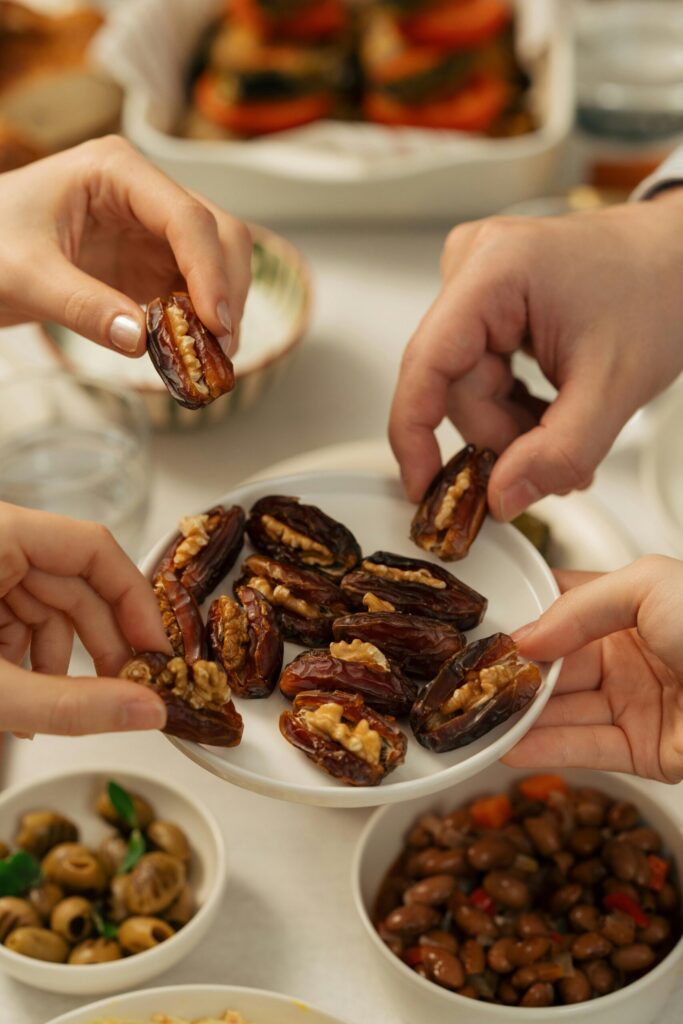
- First, eat a date.
- No dates? A few sips of water are enough.
This very simple ritual prepares the body after a day without swallowing anything. Right afterward, the Maghrib prayer is performed before moving on to the actual meal. This keeps the spiritual dimension at the center of iftar.
Then comes the full meal: soups, fruits, breads, traditional dishes… Start slowly, savor, and share. If you don’t have dates, don’t worry: water works too. What matters is the intention.
Practical tips for a successful iftar
To make sure iftar goes well, here are a few tips to keep in mind:
- Set the table a little ahead of time to avoid stress.
- Start with light foods: fruits, soups, compotes.
- Drink water in small sips to rehydrate properly.
- Avoid eating too fast or too much at once, to go easy on your stomach.
- Share iftar with others, even by video call if needed, to keep the atmosphere friendly.
- Give yourself a few moments of calm after breaking the fast.
- Vary the menus for balance; it keeps you motivated all month long.
A successful iftar is above all a moment of serenity, gratitude, and exchange. And if the soup is missing, no problem: what matters is sincerity and respect for the ritual.
Which acts break or interrupt the fast?
List of acts to avoid
Certain acts make the fast invalid. Absolutely avoid:
- Eating or drinking intentionally, even a tiny amount
- Vomiting intentionally (involuntary vomiting, however, does not count)
- Having intimate relations during the day
- Taking medication by mouth (tablets, syrups…)
Other acts, such as brushing your teeth or wearing perfume, are permitted as long as nothing is swallowed. If in doubt, ask a knowledgeable person. It is better to check than to have to make up a day later.
Special cases and valid excuses
In some cases, breaking the fast is not only permitted but advised. Here are the main situations:
- Illness requiring treatment or regular eating
- A long, tiring journey that makes fasting difficult
- Health problem (dehydration, feeling faint…)
- For women: menstruation, pregnancy, childbirth
In these cases, religion provides for making up the fast later, or giving alms depending on the situation. What matters is respecting these exemptions, which exist to protect health.
For each case, there are specific rules to compensate for missed days. Don’t hesitate to ask a trusted person for advice or to consult a guide. Ramadan is also about learning to be kind to yourself.
Conclusion
The breaking of the fast is truly one of the great moments of Ramadan. Between spirituality and conviviality, everything comes down to respecting the time, the supplication, and the traditional practices. The rules are simple, the traditions full of meaning, and every detail counts in making this moment unique. Whether you are surrounded by others or on your own, iftar remains a moment of peace and gratitude, to be lived to the fullest.
FAQ
The most commonly used phrase is:
« Allahumma inni laka sumtu wa ‘ala rizqika-aftartu »
(“O Allah, it is for You that I have fasted and it is with Your provision that I break my fast.”)
You can say it in Arabic, phonetically or in your own language. What matters most is saying it from the heart.
Iftar takes place at sunset (maghrib). To find out the exact time where you are, check a local calendar, a mobile app or your mosque‘s website. The times change every day, so keep an eye on the daily information.
Keep in mind:
- Eating or drinking intentionally
- Having intimate relations
- Taking medication by mouth
- Vomiting intentionally
If any doubt remains, ask a religious scholar.
If you eat or drink by forgetfulness, the fast remains valid. As soon as you realize, stop and continue until sunset. Forgetting is not considered a fault here.
The rule is the same everywhere: you break the fast at sunset, with a supplication. After that, everyone has their own culinary traditions:
- Soups and bricks in the Maghreb
- Sweet pastries in Turkey
- Spicy dishes in South Asia
But the heart of the ritual (the time, the intention, the supplication) remains the same, wherever you are.