


The hijab in Islam is a topic people love to talk about. Many wonder where it comes from, what the texts really say, or whether it is mandatory or not. Here, no overthinking: we take a look at the origin, the texts, and the meaning of the veil in the Muslim tradition. The idea is to give you clear basics, without bias.
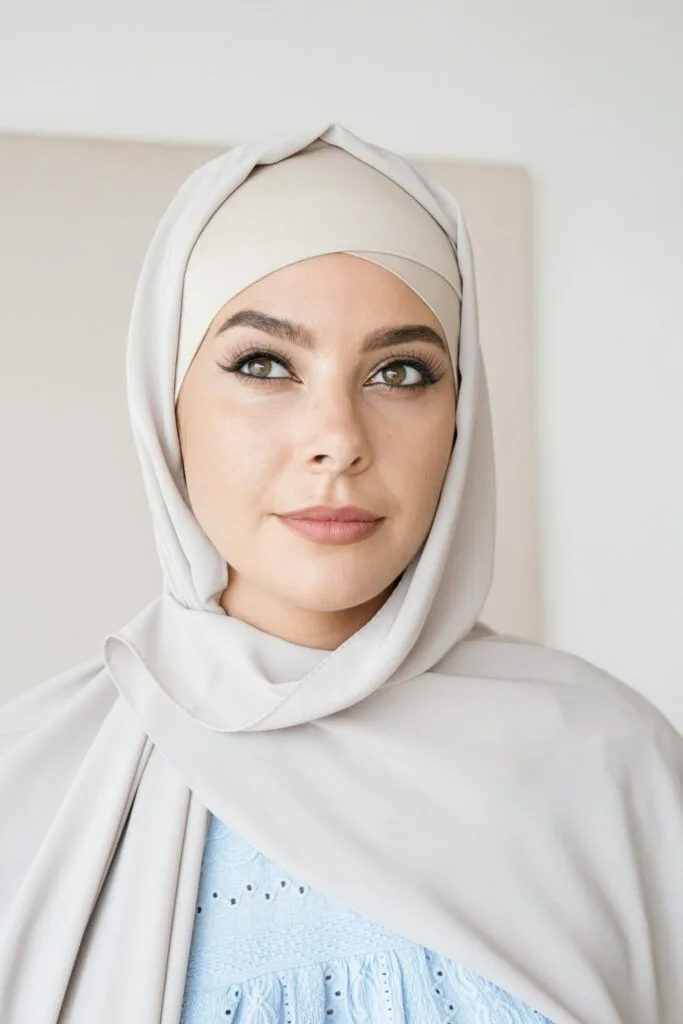
Origin of the veil in Islam: history and context
The veil is not just a story about a piece of fabric placed on the head. Before becoming a religious symbol, it passed through many eras and cultures, each with its own codes.
The veil before Islam: historical influences
Long before the arrival of Islam in the 7th century, women were already wearing the veil. In Mesopotamia, Persia, or Rome, it was used to show one’s social status or to signal that one belonged to a certain class. Among the Greeks and Romans, the veil often distinguished free women from slaves. In ancient Jewish and Christian traditions, covering the head was also common, especially in places of worship.
In short, the veil was not invented by Islam. It is part of a long history of dress codes linked to modesty, religion, or society.
Before Islam, the veil served several purposes:
- Marking social belonging: noblewomen, wives, widows…
- Signaling modesty: in some cultures, covering the hair was a matter of decency.
- Observing religious rituals: in temples or during ceremonies.
What we see is that the veil, long before being associated with Islam, was already a sign of distinction or respectability. It evolved over time, adapting to the values of each era. You could almost say the veil has had more lives than some heroes of mythology.
Adoption of the veil in Muslim society
When Islam arrives in Arabia, the veil takes on a new place. It gradually becomes part of the social and religious practices of the first Muslims. The foundational texts, the Quran and the Sunnah, speak about the veil, but in a very specific context: that of 7th-century Arab society, with its own rules of modesty and respect.
Over time, the wearing of the veil spread throughout the Muslim world, but with variations depending on regions, cultures, and eras.
Here is how it happened:
- Beginning of Islam: the veil is first for the women close to the Prophet.
- Gradual spread: the practice widens, especially encouraged for believing women.
- Diversity of styles: depending on the region, you find all kinds of veils (khimar, hijab, niqab, chador…).
The veil has therefore adapted to each culture. It has never been identical everywhere, neither in its form nor in its meaning. This diversity also explains why the debate remains open about its religious and social significance.
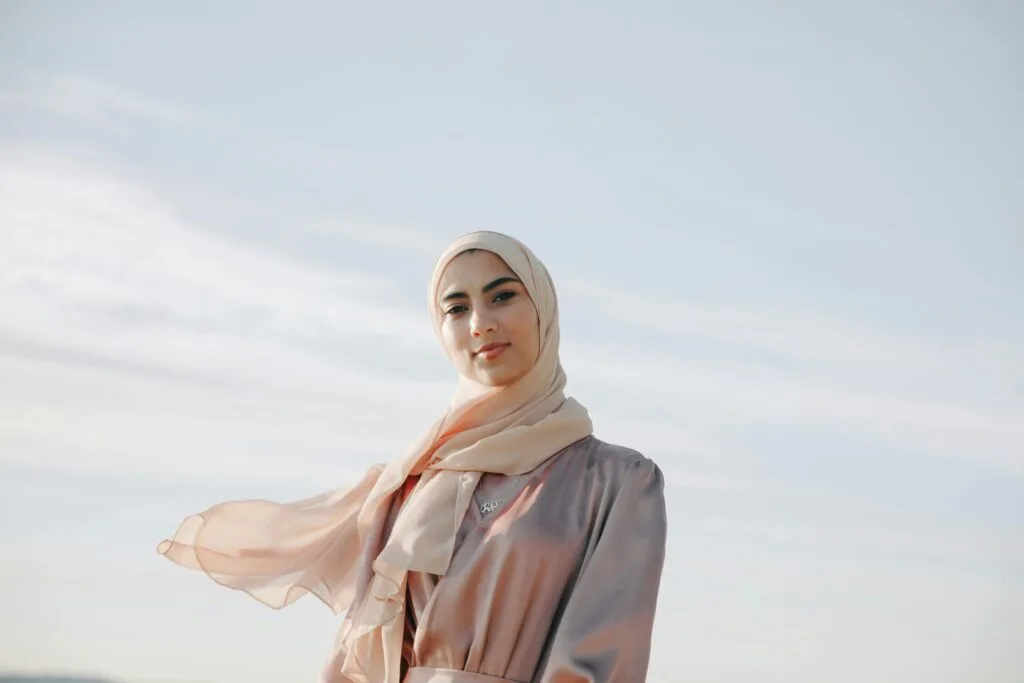
The veil in the sacred texts: Quran and hadiths
To understand the veil in Islam, you have to go back to the source: the Quran and the hadiths. But what do they actually say?
The Quranic verses on the veil
The Quran speaks about the veil in several verses, mainly in two surahs:
- Surah 24, verse 31: “Tell the believing women to lower their gaze, to remain chaste, and not to display their adornments except what is apparent, and to draw their veil (khimar) over their chests…”
- Surah 33, verse 59: “O Prophet! Tell your wives, your daughters, and the women of the believers to draw their cloaks (jalabib) over themselves. That is more suitable for them to be recognized and not to be harmed…”
These verses emphasize modesty and respect, but do not give precise details about the shape or color of the veil. The words “khimar” and “jalabib” refer to garments that cover the head and chest, but their interpretation varies depending on the school of thought.
A quick vocabulary note:
- Khimar: veil covering the head and chest
- Jalabib: large veil or loose cloak
The Quran therefore puts the emphasis on an attitude of modesty, without a single model. Scholars do not all agree on the scope of these prescriptions. Some see mainly the spiritual dimension, others emphasize the garment. But all agree on the idea of respect and protection.
The hadiths and the prophetic tradition
The hadiths are the words and actions attributed to the Prophet Muhammad. They complement what the Quran says. Some speak about modesty in dress, about covering oneself, or about the difference between private and public space.
But here too, there is no precise description. The emphasis is mainly on intention: preserving modesty and respect in society.
Keep in mind:
- Emphasis on modesty: it is the intention that counts.
- Private/public spaces: the veil mainly concerns public space.
- No strict description: the tradition does not give a fixed model.
The hadiths therefore serve as a reference point, but leave room for interpretation. This flexibility explains the diversity of practices in the Muslim world. To sum up, the prophetic tradition favors the spirit over the letter of the dress code.
Is wearing the veil mandatory in Islam: what do the schools say?
The question of the obligation of the veil in Islam is a subject of debate. The Muslim legal schools do not always read the texts the same way.
The different legal interpretations
In Islamic law (fiqh), several major schools (Hanafi, Maliki, Shafi’i, Hanbali) and Shia currents have examined the question of the veil.
- Majority of schools: for them, the veil that covers the hair and chest is a religious obligation for an adult woman in front of unrelated men.
- Some scholars: a minority believe the veil is recommended but not mandatory, taking the historical context into account.
- Regional variations: practices change depending on the country and traditions. The hijab (veil over the hair) is common, while the niqab (which covers the face) remains rare and more debated.
To get a clearer picture:
| School/Current | Position on the veil |
|---|---|
| Hanafi | Obligation (hair/chest) |
| Maliki | Obligation |
| Shafi’i | Obligation |
| Hanbali | Obligation (strict view) |
| Shia currents | Obligation (with nuances) |
| Minority scholars | Recommendation |
This diversity of opinions shows that the question has not been settled once and for all. Societies and history also greatly influence these positions.
The debate over obligation or recommendation
The debate remains open. For many, the veil is a pillar of Islamic modesty, and therefore mandatory. For others, it is a recommendation tied to a specific social context, which can evolve.
One point of consensus: modesty and respect remain essential. The shape, color or style of the veil is not imposed by the texts; it is a matter of interpretation and culture.
In summary:
- Obligation: most schools, but there is debate about how it is applied.
- Recommendation: some scholars, especially today.
- Freedom of form: no text sets the color or the material.
This debate also shows that Islam adapts to societies and eras. While the question divides, above all it prompts reflection on the meaning of modesty. And, between us, fashion often evolves faster than legal opinions.
Meaning and symbolism of the veil for Muslim women
Beyond religious rules, the veil carries strong symbolism. It does not have the same meaning for all Muslim women.
The veil as a marker of identity
For some, wearing the veil is a choice that marks identity. It shows belonging to the Muslim community and affirms a faith or a conviction. Sometimes, it is also a sign of resistance or social assertion.
The veil then becomes more than a garment: it takes the form of a symbol, even a message addressed to society.
A few examples of meanings:
- Religious affirmation: expressing one’s faith visibly.
- Belonging: recognizing oneself in a group.
- Sign of autonomy: claiming the right to choose one’s own outfit.
- Social protection: sometimes, the veil helps shield a woman from outside judgment.
The veil can therefore be a personal choice, an act of faith or a social affirmation. It has no universal meaning; each woman gives it her own. A bit like an accessory whose meaning changes with the context.
Spiritual and social dimension
On a spiritual level, the veil is often experienced as an act of faith, a way of drawing closer to God and respecting religious prescriptions. It can recall values such as modesty, dignity or discretion.
Socially, wearing the veil can strengthen a sense of belonging, but it can also generate misunderstandings or debates, depending on the society and the moment.
Spiritual aspects:
- Act of worship: the desire to please God.
- Reminder of values: modesty, respect, dignity.
- Personal discipline: a daily commitment.
Social aspects:
- Integration or distinction: depending on the context, the veil brings people closer or sets them apart.
- Public debates: it sometimes crystallizes discussions about secularism or freedom.
- Community support: it can strengthen the bond with other women who share the same practice.
At the crossroads of spirituality and society, the veil remains a living subject that is constantly evolving. It calls for nuance, listening, and sometimes a bit of tact at family meals.
Frequently asked questions about the veil in Islam
There is no shortage of questions about the veil in Islam. Here are simple answers to the most common ones.
Is the veil mandatory according to the Quran?
The Quran calls for modesty and asks women to draw the veil over the chest (Surah 24, verse 31). It does not specify the exact form of the veil.
Key takeaways:
- Quranic text: emphasizes modesty, without specifying the form.
- Interpretations: the obligation comes from legal readings, not from a direct command.
- Practice: varies across cultures and schools of thought.
Is it a sin not to wear the hijab?
For most schools of thought, not wearing the hijab is seen as a failure to follow a religious prescription. But how serious it is depends on interpretations. For some, it is a sin; for others, it is a matter of individual conscience.
Key points:
- Majority of schools: failure to fulfill an obligation.
- Seriousness: varies depending on the school and the context.
- Personal dimension: individual conscience matters.
Why wear the hijab in Islam?
Wearing the hijab in Islam has several motivations: respecting modesty, affirming one’s identity, drawing closer to God, or protecting oneself from the gaze of others. Each woman finds a different meaning in it, depending on her story and her convictions.
Possible motivations:
- Religious: following a prescription.
- Identity-related: affirming one’s belonging.
- Practical: feeling protected.
- Personal: deep personal conviction, a life choice.
Conclusion
The hijab in Islam is a subject that is both complex and nuanced, at the crossroads of history, religion and society. The sacred texts speak of modesty and of the veil, but its form and whether it is obligatory are debated among schools of thought and scholars. For many Muslim women, the hijab remains a spiritual choice, a marker of identity and sometimes a social symbol. Understanding these nuances is already a step toward opening the door to respect and dialogue.
FAQ
The Quran addresses modesty as a central value and refers to the veil in certain passages. The understanding of these verses has given rise to different interpretations over time. Most scholars consider that the veil covering the hair is part of religious obligations, based on their reading of the texts and Islamic tradition.
For most schools of thought, not wearing the veil is seen as a failure to observe a religious rule. The seriousness of this failure depends on the opinions and contexts involved.
The purpose of the veil in Islam is to preserve modesty, respect religious values and, for some women, to affirm an identity or a faith.
The Quran asks women to draw their veils over their chests and to behave modestly (Surah 24, verse 31; Surah 33, verse 59). It does not specify the exact form of the veil.
The veil can reflect a religious obligation, a personal choice, a desire to draw closer to God, or an affirmation of identity. Each woman finds her own reason.