


The prescribed hijab refers to attire that complies with the rules of modesty in Islam, with specific conditions to be met. In practice, it is not just about “wearing a veil,” but about dressing in a way that covers properly, remains decent, and avoids drawing attention. In this article, you will understand what the prescribed hijab really means, discover the 8 conditions, the difference between hijab, jilbab and khimar, and above all how to apply it in everyday life, simply.
The 8 conditions of the prescribed hijab (summary)
Cover the whole body (according to the well-known opinions)
Not be transparent
Not be tight-fitting
Not resemble men’s clothing
Not resemble clothing specific to non-Muslims
Not be a garment of fame (one that attracts attention)
Not be perfumed outside the home
Be a modest and proper outfit
Definition of the prescribed hijab according to Islam
The prescribed veil, also called the prescribed hijab, holds a very special place in Muslim practice. It is not just a scarf placed on the head: it is a garment defined by clear criteria, set out in the Quran and the Sunnah. Here, we are not talking about a fashion accessory. The prescribed veil is a set of rules on how a Muslim woman covers herself, especially in public or in front of men who are not her close family (non-mahram). The idea behind all this: preserving modesty and dignity, two values that matter greatly in the Islamic tradition.
This veil does not concern the head alone. It means covering the whole body, except for the face and hands (according to the majority of opinions). This clothing choice allows a Muslim woman to affirm her modesty and her religious identity. Wearing this veil is first and foremost a spiritual act, not just a matter of culture or habit.
Difference between veil, hijab, jilbab and khimar
Several words are used to talk about veils, but each term has its own meaning. A quick overview:
- Veil: This is the all-purpose word for any fabric placed on the head, without specifying whether or not it meets religious requirements.
- Hijab: Here, we mean both the concept of modesty and the garment that covers the head and body according to Islamic criteria.
- Jilbab: Large, loose-fitting garment that falls from the head or shoulders and covers the whole body except the face and hands.
- Khimar: Long veil that covers the head, neck and chest, often down to the waist.
The prescribed veil is the one that ticks all the boxes of the religious conditions. A scarf or turban, however pretty, is not enough. Conversely, a jilbab or a loose, opaque khimar, worn properly, meets these requirements perfectly. This distinction avoids confusion and helps you better understand what is expected in terms of attire.
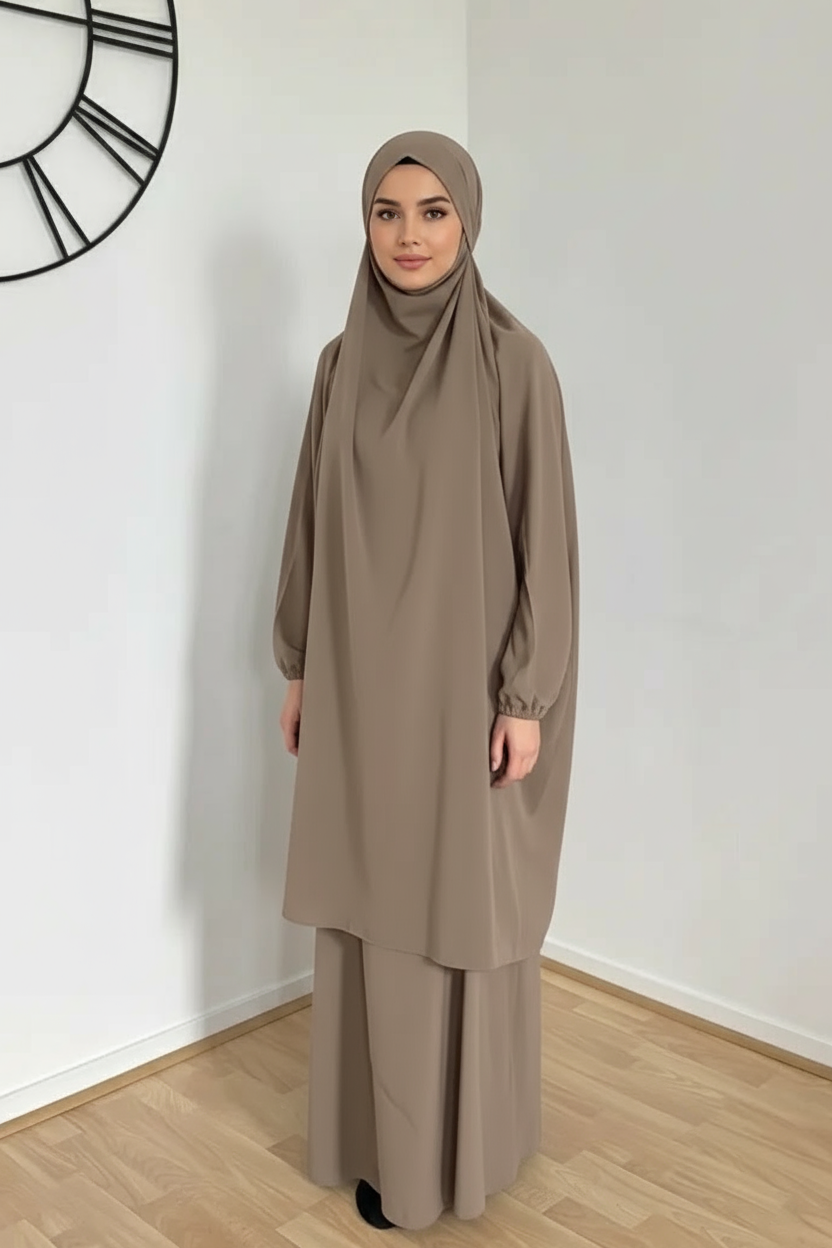
Jilbab Set
A long, full-coverage Jilbab set
Matching Khimar and skirt
The 8 conditions of the prescribed hijab
Detailed list of the 8 conditions
For a veil to be truly considered prescribed in Islam, it must meet eight specific conditions. These criteria are widely recognized by scholars and ensure that the garment fulfills its role:
1. Cover the entire body: except the face and hands (for the majority).
2. Opaque fabric: it must be thick enough that neither the skin nor the body’s shape can be seen.
3. Loose garment: it must not cling to the body, but remain wide and flowing.
4. No showy ornaments: avoid anything that shines or draws attention (sequins, flashy patterns…).
5. Unscented: the veil must not give off an attractive scent.
6. Different from men’s clothing: it must clearly stand apart from what men wear.
7. Different from the specific garments of other religions or cultures: it must not imitate dress codes foreign to Islam.
8. Not a garment of fame (libās ash-shuhra): it is not worn to attract attention or out of extravagance.
These conditions are there to preserve discretion and modesty, while keeping a certain simplicity. If any one of these rules is not followed, the veil cannot be described as prescribed.
Evidence in the Quran and the Sunnah
The Quran and the Sunnah are very clear on the subject. Two verses are often highlighted:
- Surah An-Nur (24:31): women are asked to draw their veil (khimar) over their chests, to cover what draws the eye.
- Surah Al-Ahzab (33:59): this verse encourages women to wear a large cloak (jilbab) so as to be recognized and avoid harassment.
Authentic hadiths complement these texts, emphasizing the importance of opaque fabric, a loose cut and discretion (no flashy ornaments). These references serve as the basis for the definition of the prescribed veil.
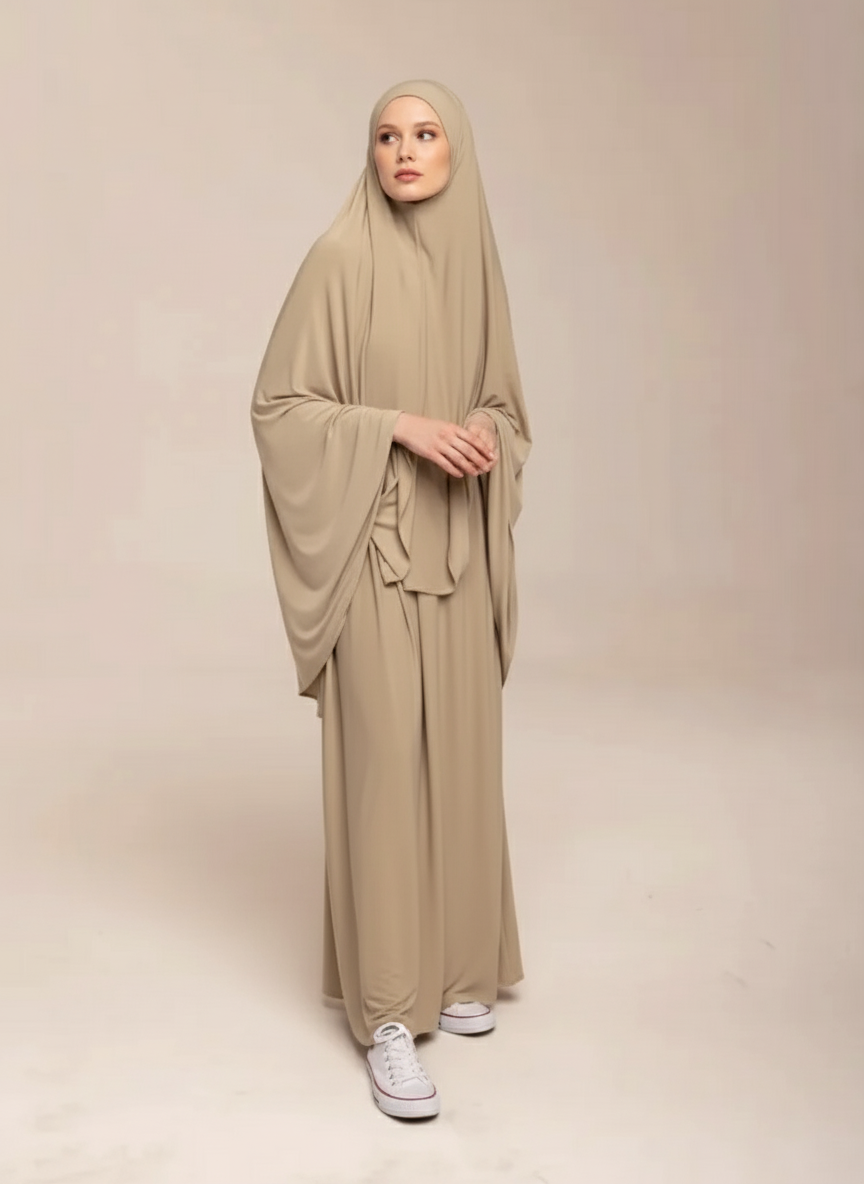
Prayer outfit
A comfortable prayer outfit
Comfortable and modest outfits – For women & men
Examples of compliant and non-compliant veils
To make things clearer, here are some concrete examples:
Compliant:
- Loose Jilbab, plain, with no shiny patterns, that comes down fully to the wrists and ankles.
- Long, opaque Khimar, covering the chest and back, paired with a loose abaya.
Non-compliant:
- Short scarf that leaves the neck or chest visible.
- Turban that leaves the ears or neck uncovered.
- Sheer veil or one that is too tight-fitting.
- Garment decorated with rhinestones, shiny patterns, or that smells of perfume.
A table to sum it up:
| Type of veil | Compliant with the prescribed veil? | Why? |
|---|---|---|
| Loose Jilbab | Yes | Covers, opaque, loose, discreet |
| Long Khimar + abaya | Yes | Covers, opaque, loose, discreet |
| Short scarf | No | Does not cover the chest |
| Turban | No | Leaves the neck/ears uncovered |
| Sheer veil | No | Lets the skin/hair show |
This table helps you spot at a glance the options that follow (or don’t follow) the rules, so you can avoid missteps. When you know what you’re looking for, everything becomes simpler.
The prescribed veil: religious obligation and scholars’ opinions
Wearing the veil in the Quran
Wearing the prescribed veil is clearly mentioned in the Quran, through verses that recall the importance of modesty and protection. The passages from Surah An-Nur and Surah Al-Ahzab are the most frequently cited: they stress covering oneself in a recognizable and discreet way. It is hard to be more explicit about the need for the veil in public spaces, in the presence of non-mahram men.
Above all, the Quran stresses the preservation of dignity and moral integrity. The prescribed veil is therefore not seen as a constraint, but as a protection and a sign of respect. This approach of modesty does not stop at clothing: it also affects behavior and the way one speaks.
Scholars’ opinions on the obligation of the prescribed veil
Nearly all Muslim scholars, across all schools of thought (Hanafi, Maliki, Shafi’i, Hanbali), agree that wearing the prescribed hijab is a religious obligation (fard) for every Muslim woman who has reached puberty, whenever she is in the presence of unrelated men. This obligation does not apply in the private sphere, meaning not in front of close family members (mahram), women or children.
There are some differences of opinion about the face and hands: some scholars believe they should also be covered, but the majority considers this unnecessary. However, the eight conditions of the prescribed hijab are agreed upon unanimously. This consensus gives the ruling weight and clarity.
Frequently asked questions about the obligation
- Is the hijab mandatory?
Yes, according to the majority of scholars, it is a clear religious ruling, not just a piece of advice.
- Is the jilbab mandatory?
What matters is to meet the eight conditions. The jilbab meets them very well, but other garments can be suitable if they fulfill the same criteria.
- Is the hijab enough?
It all depends on how it is worn. A simple scarf is not enough if the rest of the body is not covered in a loose and opaque way.
In short: the question of the obligation of the prescribed hijab is largely settled. The debates mainly concern the form, not the principle.
Practical tips for wearing the prescribed hijab every day
Dressing in line with the prescribed hijab at work and school
Wearing the prescribed hijab at work or at university is mostly a matter of preparation. A few tips:
- Choose loose, understated, solid-colored clothing to stay discreet.
- Opt for breathable, comfortable fabrics, especially if you move around a lot.
- Think about bringing a change of clothes for specific activities (sports, lab sessions…).
- If the workplace dress code requires it, go for neutral colors and avoid overly visible accessories.
- If people ask you questions, calmly explain your choices, drawing on the religious foundations.
A practical reminder: check the length of your jilbab or khimar. Stairs and public transportation don’t get along with overly long veils. Modesty is good; safety is better!
Adapting the prescribed hijab to the seasons (summer/winter)
The choice of fabrics and cuts depends on the season:
- Summer: lightweight but opaque fabrics (cotton, linen), light colors to stay cool, loose cuts to breathe more easily.
- Winter: layer up, choose warm fabrics (wool, fleece), and think about thermal underwear beneath your abaya or jilbab.
- Adjust the length of the veil so you don’t trip, especially when it’s raining or snowing.
In short: respecting the conditions of the prescribed hijab while staying comfortable is possible in any season.
Tips for combining modesty and modern style
Modesty doesn’t mean saying goodbye to style. A few ideas:
- Favor understated colors, but have fun with fabrics (cotton, crepe, jersey…).
- Accessorize subtly: a discreet brooch, a plain bag, elegant flat shoes.
- Go for modern but loose cuts: straight abayas, flowing khimars, simple jilbabs.
- Avoid piling on layers that weigh down the silhouette.
- In the end, what matters is: comfort, discretion, and confidence. Sometimes, simplicity is what makes the biggest impression.
Conclusion
The prescribed hijab is not just a garment. It is a genuine spiritual commitment, a choice of modesty and respect for religious rules. Understanding the conditions and learning to adapt it to your life is what allows you to reconcile faith, comfort and modern daily life. The key: staying true to your convictions and finding the balance between religious rigor and everyday reality. And above all, moving forward with peace of mind, keeping sincerity at the heart of the journey.
FAQ
It is a garment that covers the body of the Muslim woman according to specific rules: loose-fitting, opaque, discreet, unscented, and not resembling men’s clothing or the clothing of non-Muslims.
1. Cover the whole body (except the face and hands, according to the majority view)
2. Be opaque
3. Be loose-fitting
4. Not be flashily adorned
5. Not be perfumed
6. Not resemble men’s clothing
7. Not resemble clothing specific to non-Muslims
8. Not be a garment of fame
The veil is the broad term. The hijab is the garment that meets the Islamic rules of modesty. Not all veils are prescribed hijabs.
The jilbab is a garment that fully meets the conditions of the prescribed veil. But what matters is meeting the 8 conditions, regardless of the garment you choose.
By choosing loose, opaque, understated, unscented clothing that suits your life (work, studies, outings), while meeting the 8 conditions of the prescribed veil.