


Why recite duas during Ramadan?
Reciting duas during Ramadan is not just a habit: it is a true dialogue with God. You share your hopes, your regrets, your needs, everything that weighs on you or reassures you. The holy month gives each invocation a particular importance, as if every word counted double. Duas are used to ask for mercy, for the strength to keep the fast, for protection from mistakes, or simply to give thanks for what you already have. There are no criteria, no required age or level: anyone can recite them, out loud or silently, alone or surrounded by others.
Why include duas during Ramadan?
- To strengthen your connection with God
- To find comfort when fatigue sets in
- To ask for help with everyday decisions
- To give thanks for health, family, and sustenance
- To remember that every day is a new chance
A little extra: feel free to add your own words alongside the classic formulas. It makes it even more personal.
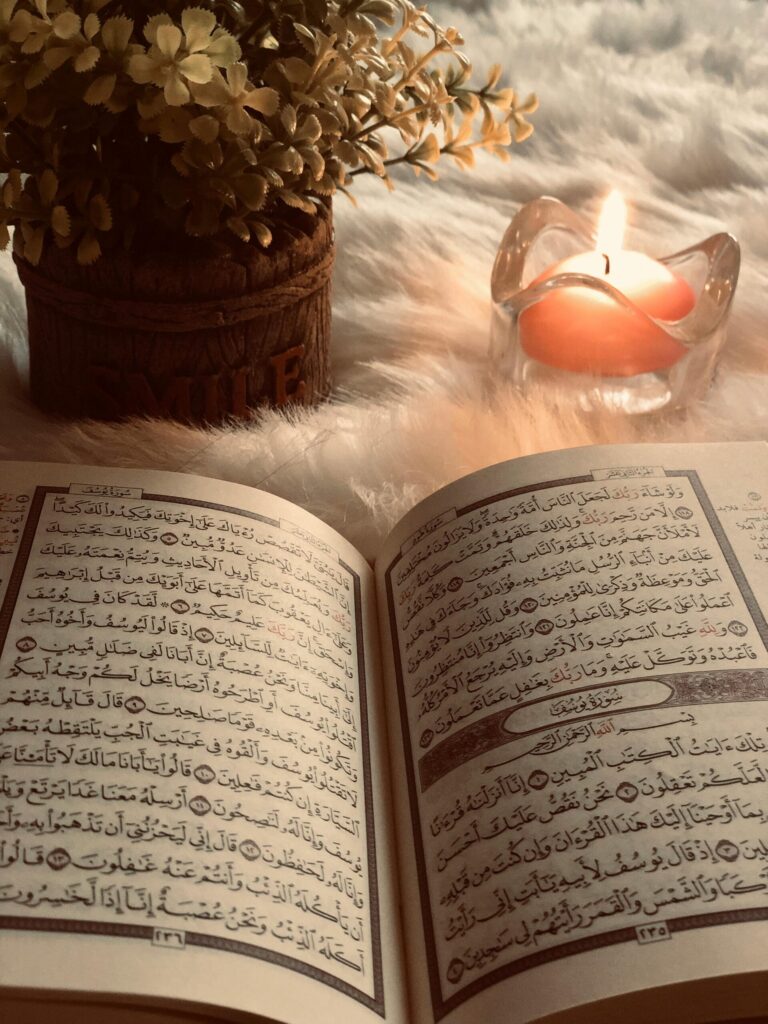
How to pronounce duas correctly?
The pronunciation of duas can feel a little intimidating at first, especially if Arabic is not your language. But don’t panic: what matters most is sincerity. The phonetics are just a guide to get as close as possible, without pressure. Here are a few tips to progress gently:
- Listen to reliable recordings to pick up the sounds
- Repeat slowly, phrase by phrase
- Focus on clarity, not speed
- Ask for advice from someone who is used to it
- Use the phonetics to find your bearings, and don’t worry about small mistakes
Keep in mind: God understands every language and every intention. The heart matters more than perfect pronunciation.
Summary table of the main duas (Arabic, phonetics, translation)
| Moment | Arabic | Phonetics | English translation |
|---|---|---|---|
| Start of Ramadan | اللَّهُمَّ أَهِلَّهُ عَلَيْنَا بِالْيُمْنِ وَالإِيمَانِ | Allahumma ahillahu ‘alayna bil-yumni wal-iman | O Allah, let this month begin for us with happiness and faith. |
| Breaking the fast (iftar) | اللَّهُمَّ إِنِّي لَكَ صُمْتُ وَبِكَ آمَنْتُ وَعَلَيْكَ تَوَكَّلْتُ | Allahumma inni laka sumtu wa bika amantu wa ‘alayka tawakkaltu | O Allah, it is for You that I have fasted, in You that I believe, and in You that I place my trust. |
| After iftar | ذَهَبَ الظَّمَأُ وَابْتَلَّتِ الْعُرُوقُ وَثَبَتَ الأَجْرُ إِنْ شَاءَ اللهُ | Dhahaba adh-dhama’u wabtallati al-‘urooqu wa thabata al-ajru in sha Allah | The thirst is gone, the veins are moistened, and the reward is confirmed, if Allah wills. |
| Last ten nights (Laylat al-Qadr) | اللَّهُمَّ إِنَّكَ عَفُوٌّ تُحِبُّ الْعَفْوَ فَاعْفُ عَنِّي | Allahumma innaka ‘afuwwun tuhibbul-‘afwa fa‘fu ‘anni | O Allah, You are Forgiving and You love forgiveness, so forgive me. |
This table is a bit like your handy reminder, so you don’t have to look for the right invocation at the last minute. Very practical, especially when your memory starts to tire at the end of the day.
Invocation for the start of Ramadan: what to say when the month arrives?
Dua to recite when seeing the crescent moon
Seeing the crescent moon is the real starting signal of Ramadan. This moment announces a new cycle, full of hope. Tradition invites us to recite a special invocation while looking at the moon. This dua is both simple and profound: it asks for a month marked by happiness, faith, safety, and peace. To experience it fully:
- Look at the crescent moon, with full awareness
- Recite the dua, in a low voice or in your mind
- Take a moment to reflect on each word: every term is a blessing to ask for yourself and for everyone
A very simple gesture, but one that sets the tone for the entire month ahead.
Meaning and context of this invocation
This invocation is not just a welcome phrase. It truly marks the passage from one cycle to the next, a leap into a time when spirituality takes center stage. By reciting it, you ask God to place the month under the sign of peace, well-being, faith, and safety. It is also a way of remembering that time belongs to God, and that every month that begins is a new opportunity to move forward. This gesture, shared by millions of people, creates a real sense of unity. Ramadan then becomes a moment to start over from zero, with new hopes.
Dua for breaking the fast (iftar): which invocation to say?
Arabic text, phonetics, and translation
At the time of iftar, when it is time to break the fast, tradition suggests reciting one or two specific duas. These invocations are there to thank God for the strength given throughout the day and for the food that is about to arrive. To do it well:
- Recite the main dua before the first bite
- If you wish, add the second one right after
- Take a few seconds to feel gratitude and peace
It isn’t mandatory, but it adds a spiritual dimension to this long-awaited moment. It’s also a reminder that food is a gift, and that every day of fasting is a small victory over oneself.
Understanding the practice at iftar
Iftar is a powerful moment, for both body and mind. After a long day, you feel like diving straight into the food. Yet taking a few seconds for a dua changes everything. It allows you to:
- Mark the transition between effort and reward
- Settle down before eating
- Share a moment of reflection with family or friends
- Remember that patience is truly the heart of Ramadan
Traditionally, you begin with a date or water, then recite the dua. This very simple ritual gives meaning to every meal. And if you ever forget, no stress: it’s the intention that counts.
Duas for the last ten nights of Ramadan (Laylat al-Qadr)
Recommended dua for Laylat al-Qadr
The last ten nights of Ramadan are the most intense. In the midst of them is Laylat al-Qadr, the famous Night of Destiny. The Prophet Muhammad ﷺ advised increasing invocations, especially this one, very short but very powerful. To include it in your prayers:
- Recite it several times during the night, especially during the night prayers
- Take a moment to reflect on forgiveness and mercy
- Feel free to personalize it according to your needs or for your loved ones
This dua is a true distillation of spirituality. It reminds us that God’s forgiveness is always there, and that asking for forgiveness is a sign of strength. Keep it in mind, it can be useful far more often than you might think.
Why are these nights special?
The last ten nights of Ramadan are synonymous with seeking and intensity. Laylat al-Qadr, hidden among them, is described as “better than a thousand months.” Above all, it is:
- The time to ask forgiveness for one’s mistakes
- The time to make wishes for the future
- The opportunity to pray for your loved ones and for the community
- The right moment to renew your intentions and strengthen your faith
The duas of these nights are precious. Tradition says they are heard with particular attention. It’s the time to take stock, to open up, without holding back. And if words fail you, the recommended dua more than does the job.
Ramadan dua to print or listen to
Downloadable PDF with all the duas
To help you memorize and pass on the duas, a summary PDF is available. It gathers all the main invocations of Ramadan: in Arabic, in phonetics and in French. This resource is designed to be:
- Easy to print and hang at home
- Handy to consult during prayers or meals
- Ideal for children or beginners
- A real plus for learning as a family or in a group
No need to learn everything at once. The PDF is there to support you, not to put pressure on you. A quick glance before iftar, and you’re set!
Download the Ramadan duas PDF: Invocations Ramadan PDF Gratuit | PDF | Allah | Jurisprudence islamique
Audio or videos to practice pronunciation
Pronunciation comes with practice. For that, audio / video files are provided. They allow you to:
- Listen to the pronunciation, word by word
- Repeat calmly, at your own pace
- Practice alone or with others
- Gain confidence, day after day
By listening regularly, you memorize better and pronounce more naturally. Even if it isn’t perfect, that’s okay: what matters is progress and sincerity. And who knows, you may become the go-to person for duas among those around you!
Listen to this beautiful recitation:
Conclusion
Ramadan is above all a month of returning to the essentials, of spirituality and sharing. The duas, these short and profound invocations, mark every stage: the start of the month, breaking the fast, the special nights. Reciting them, understanding them and bringing them into your daily life gives more meaning to every moment. With the Arabic versions, the phonetics, the translations, and the resources to print or listen to, everyone can experience a more peaceful, more authentic Ramadan. What matters is to approach it with a sincere intention and to move forward at your own pace. Ramadan is not a race, it’s a journey.
FAQ
The dua to recite when seeing the crescent moon:
“Allahumma ahillahu ‘alayna bil-yumni wal-iman was-salamati wal-islam, rabbi wa rabbuka Allah.”
Translation: “O Allah, let this month begin for us with joy, faith, safety and Islam.”
“Allahumma inni laka sumtu wa bika amantu wa ‘alayka tawakkaltu wa ‘ala rizqika-aftartu.”
Translation: “O Allah, I fasted for You, I believe in You, I place my trust in You, and I break my fast with Your provision.”
“Allahumma innaka ‘afuwwun tuhibbul-‘afwa fa‘fu ‘anni.”
Translation: “O Allah, You are Forgiving and You love forgiveness, so forgive me.”
You will find every dua in the summary table of this article, in Arabic, phonetics and translation. A downloadable PDF and audio files are also available.
Yes, a printable PDF and audio files are available to help with memorization and pronunciation. Use them at home, with family or during prayers.