


Preparing Your Hair and Choosing Your Underscarf Cap Before Putting On the Hijab
Before putting on your scarf, it’s worth taking a little time to prepare your hair and choose the right cap. This small step changes everything: you get comfort and a better look, and you avoid common problems like itching, slipping or marks on the forehead. The idea is to:
- Detangle your hair thoroughly, to avoid bumps and knots under the scarf.
- Tie it in a low bun or a low ponytail, depending on the length. That way the volume stays evenly distributed and nothing moves.
For the cap, there are several options:
- Cotton, for those who want a breathable fabric.
- Non-slip models, perfect if your fabric slips easily.
- Caps with an elastic band, which adapt without being too tight.
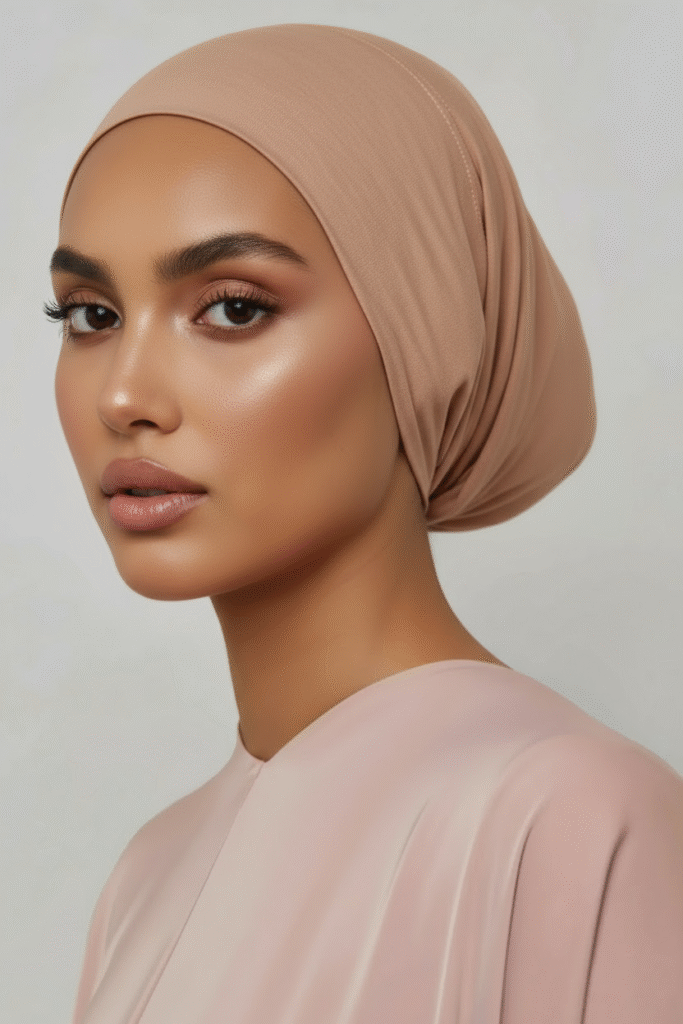
A quick tip for sensitive scalps: opt for very soft, hypoallergenic materials.
In short, the points to check:
- Detangling and tying your hair low.
- A cap that matches your needs (cotton, non-slip, elastic…).
- Nothing too tight, to avoid marks.
- Check that everything is smooth before putting on the scarf.
A well-placed cap is the foundation for a scarf that stays put from morning to night, hassle-free. And as for color, black always works, but nothing stops you from playing with colors that go with your scarf.
Choosing the type of scarf or hijab that suits your style
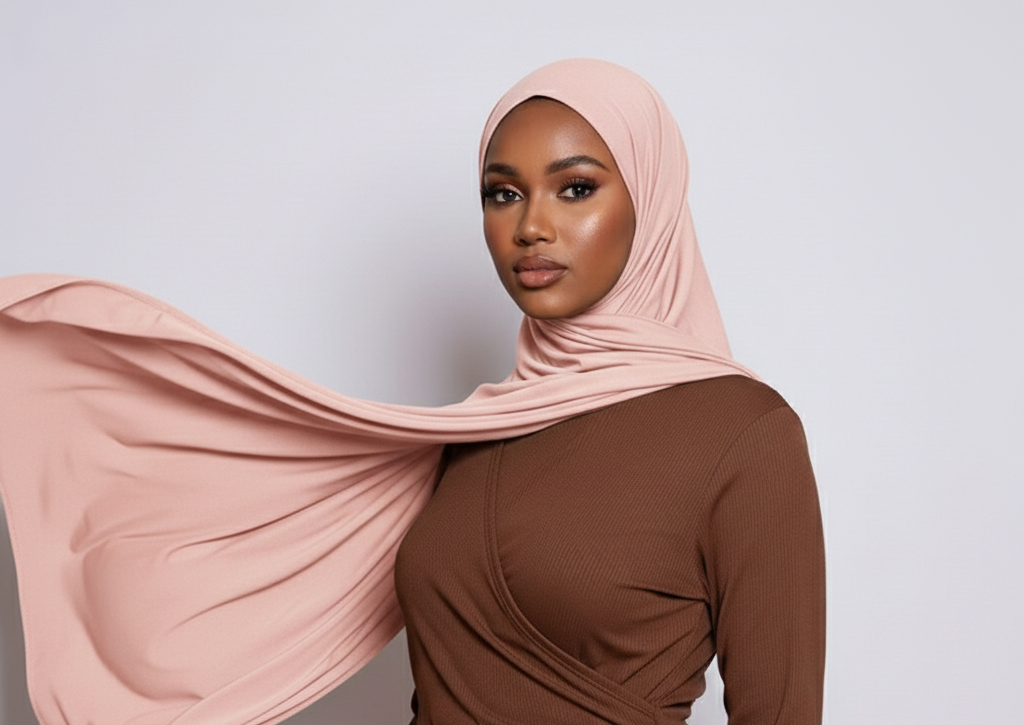
Choosing your scarf or hijab is a mix of your style, the fabric and the occasion. Each fabric has its advantages: some are extremely easy to handle, others give a more chic or understated look. To start, fabrics that hold well like jersey or cotton are your best allies: easy to put on, they don’t slip and need few adjustments. Ideal for everyday wear.
Want a more elegant effect for a special occasion? Chiffon or silk instantly look dressier, but require a bit more technique to stay in place (pins or discreet clips are often needed).
As for shape, it’s a matter of preference:
- Rectangular hijab: very versatile, with several styles possible.
- Square hijab: shorter, perfect for a classic look or a ceremony.
To remember:
- Jersey and cotton: practical, stable, perfect for everyday life.
- Chiffon and silk: more refined, but require a bit of technique.
- Rectangular hijab: to vary your styles.
- Square hijab: for a classic look.
Don’t hesitate to change fabric or shape depending on your mood or the weather. The scarf is also about comfort and the pleasure of getting dressed.
Step-by-Step Tutorial: How to Put On Your Scarf Easily
Time to practice! Here is a simple tutorial for putting on your scarf, even if it’s your first time. The goal: a neat, comfortable look that doesn’t move.
1. Place the scarf on your head, leaving one side longer than the other. This slight offset helps with the drape.
2. Adjust the edge on your forehead, rounded or straight, depending on what suits your face best.
3. Bring both ends under your chin and cross them.
4. Secure with a pin under the chin, or tie a discreet knot if the fabric allows.
5. For a more elaborate style, wrap the longer end around your head or let it fall over your shoulder.
A few tips to make it easier:
- Flat pins or hijab clips for thin fabrics.
- For jersey or thick fabrics, a simple knot is often enough.
- If you want to avoid pins, go for a non-slip cap and a fabric that grips.
- Check that the scarf isn’t too tight around the neck, so you stay comfortable all day.
A well-placed scarf is mostly a matter of small, precise movements and adjustments. And if a fold doesn’t fall as planned, don’t stress: no one gets it right the first time.
Different Ways to Wear the Scarf Depending on the Fabric or Occasion
Changing your scarf style is very easy and lets you adapt to every situation: daily routine, a date, or an event. The scarf fabric changes everything, in both technique and look. For example:
- With jersey: perfect for mornings when everything has to go fast. Place it, adjust the front, cross under the chin, bring the long end around the neck. No pins needed, it holds on its own.
- For a modern style: go for simplicity, few folds, a natural drape, sometimes just a small, nearly invisible pin.
- Traditional style: play with layering and folds for a more structured, dressier result.
Also adapt it to your face shape:
| Face shape | Hijab tip |
|---|---|
| Round | Pointed edge on the forehead, it elongates |
| Oval | Every style suits you, have fun |
| Square | Rounded drape, to soften the angles |
| Long | Worn low on the forehead, avoid high folds |
Don’t hesitate to try different techniques depending on the fabric or the occasion. Sometimes, just a small change in the drape and you have a whole new style, effortlessly.
The conditions to follow when wearing the hijab in Islam
Wearing the hijab in Islam is not just a matter of style. There are rules to follow, to preserve modesty and avoid drawing too much attention. The 8 conditions of the prescribed hijab are simple, but important. They remind us, for example, that the whole body must be covered (except the face and hands), that the fabric must be opaque and loose, and that one should not try to stand out in a flashy way.
Quick summary table:
| Condition | Short explanation |
|---|---|
| Cover the body | Except face and hands |
| Be opaque | Nothing should reveal the skin |
| Be loose | Do not cling to the figure |
| Do not resemble men’s clothing | Keep a clear distinction |
| No excessive adornment | Keep it simple, no flashy embellishments |
| No perfume | No scent that draws attention |
| No celebrity clothing | Avoid anything that gives a “star look” |
| No ostentation | Discretion, always |
For comfort and compliance with the rules, aim for breathable fabrics, opaque ones, and loose cuts. Neutral colors are great for everyday, but nothing stops you from adding a touch of elegance for an occasion, as long as it stays discreet. The key is to find the balance: comfortable in your clothes, and in line with the principles.
Conclusion
Putting on the hijab isn’t complicated once you have the right basics. A well-placed under-cap, a suitable fabric, a few tips — and you’re done for a neat, comfortable and elegant result. Change your style according to your preferences, your face shape or the occasion. Keep the essential conditions in mind, for a serene and respectful way of wearing the hijab. With a little practice, everything becomes natural, and the hijab finds its place in your daily life.
FAQ
Prepare your hair, choose a suitable under cap, then put on the hijab while respecting the 8 main conditions (coverage, opacity, looseness, modesty, etc.).
Choose a fabric that grips, such as jersey or cotton. Use a non-slip under cap, cross the ends under your chin or behind your neck, and you’re done. No pins needed.
They are: covering the whole body except the face and hands, opaque fabric, looseness, not resembling men’s clothing, no excessive adornment, no perfume, no celebrity-style clothing, no ostentation.
Adapt the drape to your face shape: rounded for square faces, a point on the forehead for round faces, a low wear for long faces, and for oval faces, anything goes.
Position the underscarf properly, choose a fabric that stays in place, adjust each fold, and if needed, add a discreet pin behind the head. A well-placed hijab doesn’t move, even after several hours.
Leave a Reply